

How Custom Corrugated Boxes Support Product Protection and Consistent Business Branding
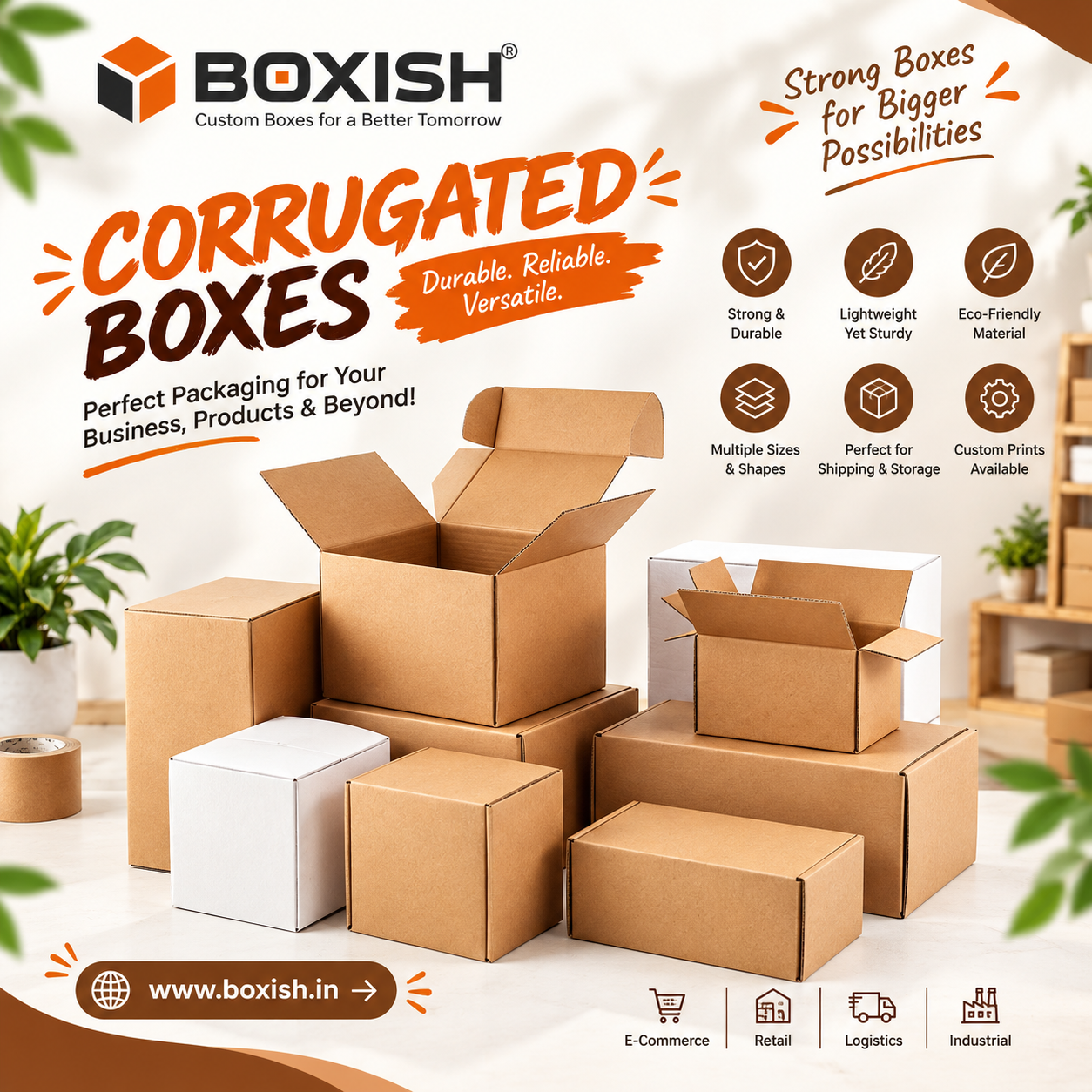
Packaging plays an important role in how businesses protect products, manage shipping, and present their brand to customers. For ecommerce sellers, retailers, manufacturers, wholesalers, and distributors, standard packaging may not always fit every product or business requirement.
Custom corrugated boxes allow businesses to select packaging dimensions, board construction, printing, and other specifications according to their products and operations. A properly designed box can help reduce unnecessary product movement, improve packing efficiency, and create a more consistent brand presentation.
Whether a business ships lightweight accessories, fragile products, retail merchandise, or larger industrial items, the right packaging should balance product protection with practical design and branding requirements.
This guide explains how custom corrugated boxes support safer product handling, consistent branding, and more organized packaging operations.
What Are Custom Corrugated Boxes?
Custom corrugated boxes are packaging containers designed or produced according to specific business requirements. Instead of relying entirely on standard sizes and designs, businesses can consider dimensions, board construction, printing, and box styles suited to their products.
Corrugated board generally consists of flat paper liners and one or more fluted layers. These layers contribute to rigidity, cushioning, and resistance to compression.
Depending on the supplier's capabilities, businesses may customize:
-
Box length, width, and height
-
Ply and board construction
-
Paper specifications
-
Printing and logo placement
-
Box style and closing method
-
Internal inserts or dividers
-
Packaging quantities
The available options depend on production capabilities, order quantities, and the intended application.
Why Businesses Choose Custom Corrugated Boxes
Custom packaging can help businesses address product-specific requirements that standard boxes may not meet efficiently.
1. Better Product Fit
A box designed around the product can provide sufficient space for the contents and any required protective materials without leaving excessive empty space.
This can be particularly useful for products with unusual dimensions or businesses that regularly ship the same product range.
2. More Consistent Packaging
Using established box specifications for specific products can help employees follow a consistent packing process.
Businesses can maintain approved sizes and constructions for different product categories, making repeat orders and inventory planning easier.
3. Improved Product Presentation
Custom boxes can display a brand's logo, colours, business name, or other visual elements.
This helps businesses maintain a consistent appearance across their packaging and other customer-facing materials.
4. Practical Packaging Operations
A suitable box design can make assembly, filling, closing, and sealing easier for packing teams.
The objective is to select packaging that fits the product and works efficiently within the business's existing workflow.
5. Flexible Packaging Specifications
Different products have different requirements. Customization allows businesses to evaluate the dimensions, board construction, and internal protection needed for each application.
However, customization should be based on actual product requirements rather than adding unnecessary features.
How Custom Corrugated Boxes Improve Product Protection
Product protection is one of the main reasons businesses consider custom packaging.
During transportation, packages may experience vibration, stacking pressure, loading, unloading, and repeated handling. A suitable box creates an outer structure around the product and can help it withstand these conditions.
Choosing the Right Dimensions
An oversized box can allow the product to move around during transportation. An undersized box may place pressure on the contents or leave insufficient space for cushioning.
Custom dimensions can help businesses achieve a more practical fit.
Before selecting a size, measure the product's length, width, and height. Then allow for any required internal protection and confirm whether the supplier's dimensions refer to the inside or outside of the box.
Selecting Suitable Board Construction
The appropriate board construction depends on product weight, dimensions, fragility, stacking requirements, and transportation conditions.
Three-ply construction can suit many lightweight and moderately weighted applications, while five-ply construction may be considered when greater rigidity and structural support are required.
Ply alone does not determine box strength. Paper quality, flute construction, dimensions, joint quality, and manufacturing consistency also affect performance.
Reducing Unnecessary Movement
A box designed for a specific product can reduce excessive empty space and make it easier to position internal cushioning or inserts.
This is particularly important for fragile products, electronics, and orders containing multiple items.
Custom packaging should be tested with the actual product to confirm that the contents remain suitably positioned during normal handling.
Custom Corrugated Boxes for Ecommerce Businesses
Ecommerce businesses often send products through multiple logistics stages before they reach customers.
A typical order may travel through:
Warehouse → Pickup → Sorting Centre → Transportation Hub → Local Delivery → Customer
At each stage, the package may be moved, stacked, or handled alongside other shipments.
Custom corrugated boxes can help ecommerce businesses select packaging dimensions and construction according to their product range.
For example, a business selling accessories may need compact boxes, while a home-products retailer may require larger packaging for multi-item orders.
A consistent range of suitable box sizes can also help employees select packaging more quickly and reduce unnecessary filler material.
Custom Packaging for Retail and Wholesale Businesses
Retailers and wholesalers use packaging for inventory storage, supplier deliveries, store transfers, and customer orders.
Custom boxes can help businesses accommodate products that do not fit standard dimensions efficiently.
For example, a retailer may need different boxes for small accessories, individual garments, and multiple-product shipments. A wholesaler may require packaging that supports stacking and organized distribution.
Standardizing box specifications for recurring orders can help simplify purchasing, storage, and handling.
Custom Corrugated Boxes for Manufacturing and Industrial Products
Manufacturers may require packaging for components, spare parts, finished goods, and products moving between production facilities or warehouses.
These products can vary considerably in weight, shape, and sensitivity.
Before designing custom packaging, businesses should evaluate:
-
Product dimensions and weight
-
Surface sensitivity
-
Required structural support
-
Stacking and storage conditions
-
Transportation distance
-
Internal support requirements
Heavy or sensitive products may need a suitable combination of board construction, inserts, dividers, or other protective materials.
The final packaging specification should be based on the actual application and tested before large-scale production.
How Custom Boxes Support Consistent Business Branding
Packaging is often one of the physical touchpoints through which customers interact with a business. A consistent design can connect the delivery package with the company's website, storefront, product labels, and other marketing materials.
Custom corrugated boxes can provide space for several branding elements.
Logo and Business Name
A clearly placed logo and business name can help customers identify the brand when they receive an order.
Brand Colours
Using consistent colours can make packaging feel connected to the company's broader visual identity.
Product Information
Depending on the application, businesses may include product details, handling instructions, or other relevant information.
Website and Contact Details
Selected contact information can provide customers with a way to reconnect with the business after delivery.
Simple Graphics and Messaging
A short message or simple graphic can add character without making the packaging difficult to read.
The design should remain clear and practical. Too much information can make the box look crowded and reduce readability.
Custom Printing: Balancing Branding and Functionality
Printing is useful when businesses want their packaging to reflect their identity, but the design should complement the box's main purpose.
Before approving printed packaging, businesses should consider:
-
Logo size and placement
-
Artwork quality
-
Number of colours
-
Printing method
-
Surface requirements
-
Production quantity
-
Sample approval
The printing method and available finishes depend on the supplier's capabilities and the box specification.
Businesses should review a proof or sample before approving a large order. This helps identify design, colour, or placement issues before production.
Branding should not replace practical considerations such as product fit, suitable board construction, and secure closure.
Corrugated Sheets for Additional Product Protection
Custom boxes do not always provide all the protection a product needs on their own. Some applications require additional separation or protective layers inside the main package.
Corrugated Sheets can be used as dividers, separators, or protective layers between products. They may be useful when several items are packed together or when surfaces need to be separated during transportation.
For example, a business shipping multiple products in one carton can use sheets to reduce direct contact between individual items.
Businesses can explore Corrugated Sheets for packaging applications that require additional separation or protection. The appropriate sheet size and construction should match the products and the intended use.
Corrugated Rolls for Flexible Protection
Some products have irregular shapes, exposed edges, or sensitive surfaces that are difficult to protect with fixed-size inserts alone.
Corrugated Rolls provide flexible paper-based material that can be cut to the required length and wrapped around suitable products or selected areas.
They may be useful for:
-
Furniture components
-
Machinery parts
-
Glass products
-
Irregularly shaped items
-
Product edges and corners
-
Sensitive surfaces
Businesses can explore Corrugated Rolls when adjustable wrapping or surface protection is needed.
Using corrugated rolls alongside a suitable custom box can help create a more complete packaging system for products that require additional coverage.
Choosing the Right Custom Box Size and Strength
A successful custom packaging design begins with accurate product information.
Step 1: Measure the Product
Record the length, width, and height of the product or product set.
Step 2: Determine the Packed Weight
Consider the product and any materials placed inside the box.
Step 3: Assess Fragility
Identify surfaces, corners, or components that may require additional protection.
Step 4: Evaluate Shipping and Storage
Consider transportation distance, handling points, stacking, and storage duration.
Step 5: Select the Board Construction
Choose suitable ply and paper specifications according to the application's requirements.
Step 6: Decide on Internal Protection
Determine whether cushioning, dividers, inserts, corrugated sheets, or wrapping materials are necessary.
Step 7: Test a Sample
Pack the actual product and evaluate the fit, closing, sealing, movement, and handling before approving a bulk order.
This process helps businesses develop packaging around the product instead of relying on appearance alone.
How Custom Corrugated Boxes Can Help Manage Packaging Costs
Custom packaging may require additional planning, but a suitable design can help businesses use packaging materials more efficiently.
An oversized standard box may require extra filler, while an unsuitable box can increase packing time or contribute to product damage.
Businesses should evaluate the total packaging cost, including:
-
Box production cost
-
Printing and customization
-
Internal protective materials
-
Storage requirements
-
Packing labour
-
Packaging wastage
-
Potential damage and replacement costs
Custom dimensions may be particularly useful when businesses ship the same products regularly. However, the value of customization depends on order volume, design requirements, and production costs.
Testing samples and comparing total costs can help businesses decide whether a custom box is more practical than a standard option.
How Boxish Can Support Custom Packaging Requirements
Boxish provides packaging products for businesses involved in ecommerce, retail, storage, and distribution. Its product range includes corrugated boxes and other packaging materials for different business applications.
When evaluating custom packaging, businesses should identify their product dimensions, packed weight, protection requirements, printing preferences, and expected order quantities.
These details help determine which packaging specifications may be suitable. Before placing a bulk order, businesses should confirm the available customization options, production requirements, pricing, and delivery arrangements.
For products requiring additional protection, suitable corrugated sheets or corrugated rolls can also be considered as part of the overall packaging setup.
Common Mistakes to Avoid When Ordering Custom Boxes
Focusing Only on Appearance
A visually attractive box may still be unsuitable if its size or construction does not match the product.
Choosing the Wrong Dimensions
Custom dimensions should be based on accurate measurements and the space needed for internal protection.
Selecting Ply Without Assessing the Product
The number of layers should be evaluated alongside paper quality, box size, stacking, and transportation conditions.
Overcomplicating the Design
Excessive graphics and text can make branding less clear and may increase production complexity.
Ignoring Internal Protection
Fragile products may require cushioning, dividers, or inserts even when the outer box is strong.
Ordering Large Quantities Without Testing
A sample can reveal problems with product fit, printing, closure, and handling before a large production run.
Final Thoughts
Custom corrugated boxes can help businesses combine product protection, practical packaging dimensions, and consistent branding. By selecting suitable sizes, board construction, printing, and internal protection, businesses can create packaging that fits their products and supports everyday shipping and storage operations.
The right design depends on product weight, dimensions, fragility, transportation conditions, and branding requirements. Customization should solve a practical problem or improve presentation rather than add unnecessary complexity.
Corrugated Sheets can provide separation inside a package, while Corrugated Rolls can offer flexible wrapping for products with irregular shapes or sensitive surfaces.
With accurate measurements, clear specifications, sample testing, and consistent branding, businesses can build a packaging system that supports product protection and a more recognizable customer experience. Boxish is one option businesses can consider when exploring corrugated boxes and complementary packaging materials for their requirements.
Frequently Asked Questions
1. What are custom corrugated boxes?
Custom corrugated boxes are packaging containers designed or produced according to specific requirements, such as box dimensions, board construction, printing, and product protection needs.
2. How do custom corrugated boxes protect products?
A suitably designed box can provide a protective outer structure and reduce unnecessary product movement. Fragile products may also require cushioning, inserts, dividers, or other internal protection.
3. Can custom corrugated boxes improve brand consistency?
Yes. Businesses can use consistent logos, colours, typography, and design elements across their packaging to connect deliveries with their wider brand identity.
4. Should businesses choose 3-ply or 5-ply custom boxes?
The choice depends on product weight, dimensions, fragility, stacking requirements, and transportation conditions. Ply should be considered alongside paper quality and the complete box construction.
5. What information is needed to order custom corrugated boxes?
Businesses should provide product dimensions, packed weight, product fragility, intended use, internal protection requirements, printing preferences, and expected order quantities.
6. Can corrugated sheets be used inside custom boxes?
Yes. Corrugated sheets can serve as dividers, separators, or protective layers when products need additional separation inside the main box.
7. What are corrugated rolls used for?
Corrugated rolls can be cut to the required length and used to wrap suitable products or protect edges, corners, and irregular surfaces before placing items inside a box.
8. Are custom corrugated boxes suitable for ecommerce businesses?
Yes. They can be useful for ecommerce businesses that need product-specific dimensions, consistent packaging, or branded shipping boxes. The design should match the product and delivery conditions.
9. Are custom boxes always more cost-effective than standard boxes?
Not necessarily. The value depends on order volume, production costs, dimensions, filler requirements, and the benefits of a better fit. Businesses should compare total packaging costs before deciding.
10. What should businesses check before approving a custom box order?
Check the dimensions, board construction, product fit, closure, printing, internal protection, and expected handling conditions. Testing a sample with the actual product is recommended before bulk production.

 English
 French
 Spanish
 Portuguese
 Deutsch
 Turkish
 Dutch
 Italiano
 Russian
 Romaian
 Portuguese (Brazil)
 Greek
