

What testing procedures are required after completing Modular Ophthalmic OT Setup Services?
INTRODUCTION
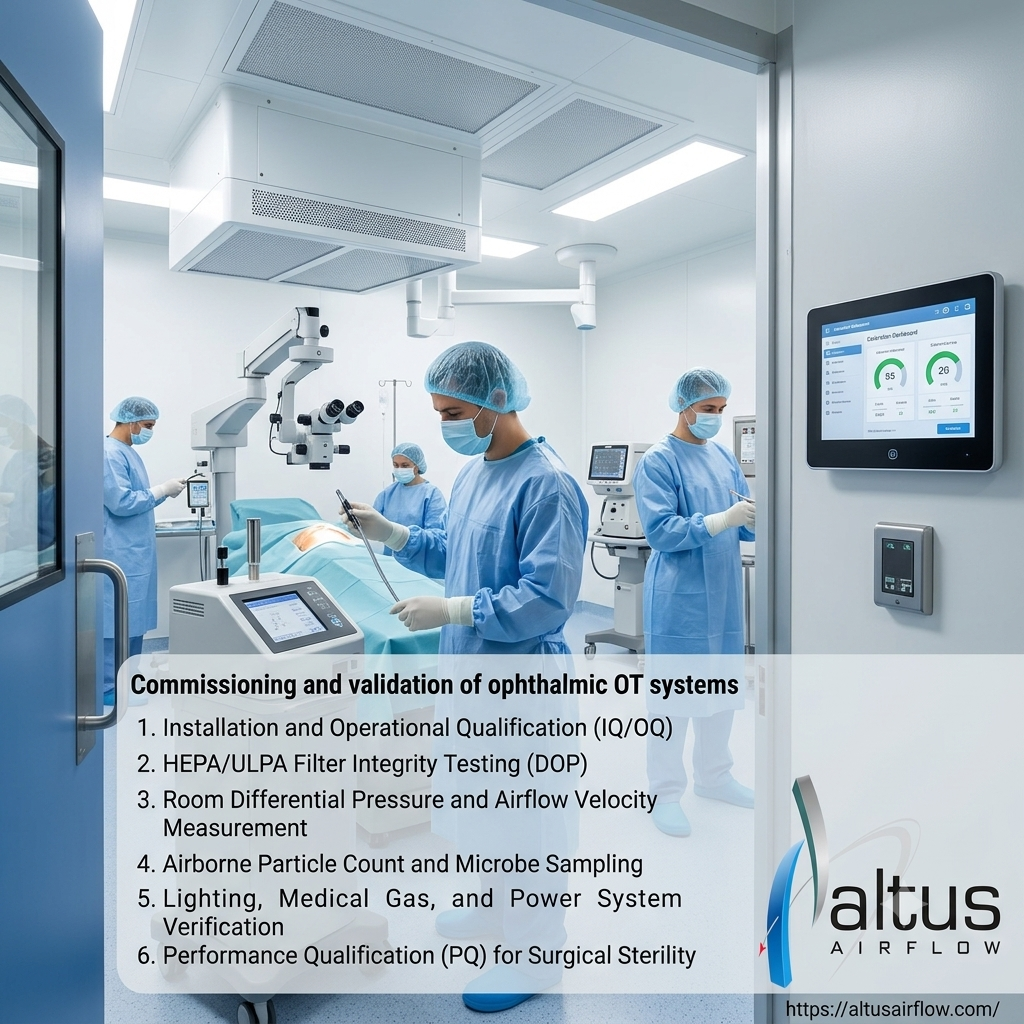
After completing Modular Ophthalmic OT Setup Services, hospitals must conduct a comprehensive series of testing and commissioning procedures to verify that the operation theatre is safe, functional, and ready for clinical use. Ophthalmic surgeries require precise environmental control, dependable equipment, effective contamination prevention, and reliable electrical and medical utility systems. Testing confirms that the installed infrastructure performs according to approved design specifications and applicable healthcare requirements. From HVAC performance and HEPA filter integrity to electrical safety, medical gas verification, and equipment functionality, every critical system should be checked before the operation theatre is handed over to the hospital.
Why Testing Is Important After Modular Ophthalmic OT Installation
Testing is an essential part of completing a modular ophthalmic operation theatre. Even when construction and installation appear satisfactory, hidden issues involving airflow, filtration, electrical connections, or utility performance may affect the theatre's readiness.
A structured commissioning process helps hospitals:
- Verify that ventilation systems operate according to design requirements.
- Confirm effective filtration and appropriate airflow direction.
- Identify installation defects before clinical use.
- Check the functionality of lighting, electrical outlets, and medical equipment.
- Verify medical gas and vacuum connections where installed.
- Confirm that environmental monitoring and alarm systems work correctly.
- Establish maintenance baselines and complete handover documentation.
The test plan should be developed according to the theatre's intended clinical use, approved specifications, applicable Indian requirements, and relevant engineering standards. ISO 14644-3 provides test methods for cleanrooms and controlled environments, while healthcare ventilation guidance provides additional context for operating theatres.
HVAC Performance Testing
Heating, ventilation, and air conditioning (HVAC) testing is one of the most important commissioning activities.
The HVAC system helps maintain the required temperature, humidity, ventilation, filtration, and pressure relationships within the operation theatre. Poor performance can compromise environmental control and affect the comfort of patients and surgical staff.
Testing should include:
- Verification of supply and return air volumes.
- Measurement of air changes per hour (ACH), where specified.
- Checking temperature and relative humidity against approved design limits.
- Verification of room pressure relationships.
- Inspection of air-handling units, dampers, ductwork, and controls.
- Checking the operation of sensors, displays, and alarms.
Measurements should be compared with the approved design criteria rather than assumed universal values. Healthcare ventilation guidance, including NHS Health Technical Memorandum 03-01, describes the design, validation, and operational management of specialised ventilation systems.
HEPA Filter Integrity Testing
High-efficiency particulate air (HEPA) filtration may be specified to control airborne particles in an ophthalmic operation theatre. However, installing a filter does not automatically prove that the filtration system is performing correctly.
HEPA filter integrity testing checks for leakage through the filter media, seals, gaskets, and filter housing, using an appropriate test method.
The procedure generally involves:
- Confirming the filter model and installation details.
- Inspecting the filter housing, seals, and mounting arrangement.
- Using suitable test equipment and a specified aerosol challenge where required by the selected method.
- Scanning the filter face, perimeter, and relevant sealing areas for leakage.
- Recording results and correcting any identified defects.
- Repeating the test after repairs or filter replacement, as applicable.
Testing should be conducted by trained personnel using calibrated equipment and a method appropriate to the installed filter system. ISO 14644-3 includes methods for testing installed filter-system leakage.
Airflow Velocity and Airflow Volume Measurement
Airflow measurements help establish whether the installed ventilation system delivers the air volume and velocity specified in the design.
Where a laminar or unidirectional airflow arrangement is installed, its performance must be evaluated against the project's intended airflow pattern and acceptance criteria.
The testing process may include:
- Measuring airflow velocity at defined locations.
- Measuring total supply airflow.
- Checking the uniformity of airflow across designated areas.
- Verifying airflow distribution around surgical lights and major equipment.
- Comparing recorded values with approved design specifications.
- Adjusting dampers or system settings where necessary.
The measurement method depends on the type of air distribution system. Results should be documented with the test locations, instrument details, operating conditions, and acceptance criteria.
Airflow Direction and Visualization Testing
Airflow visualization testing helps demonstrate how air moves through the operation theatre and whether the installed arrangement behaves as intended.
A suitable visualization method, such as an approved smoke or tracer technique, can reveal unexpected turbulence, stagnant areas, or airflow patterns affected by equipment placement.
During testing, the commissioning team should assess:
- The direction of airflow at relevant supply and return locations.
- Air movement around the operating table and surgical field.
- Potential disruption caused by surgical lights, equipment, and other obstructions.
- Air movement near doors and other openings.
- Whether observed patterns are consistent with the design intent.
Visualization findings should be reviewed alongside airflow measurements. A visual demonstration alone does not establish particle cleanliness or prove that infection risks have been eliminated.
Room Pressure Differential Testing
Pressure differential testing verifies that the theatre maintains the intended pressure relationship with adjoining rooms and corridors.
Operating theatres commonly use positive pressure relative to adjacent areas to help limit the entry of less-clean air. The exact pressure targets and room-to-room relationships must be defined by the approved design and applicable requirements.
Testing generally includes:
- Measuring pressure differences between the theatre and adjacent spaces.
- Confirming that the readings remain within the specified limits.
- Checking pressure displays and monitoring devices.
- Verifying alarm activation where pressure alarms are installed.
- Assessing the effect of door opening and closing.
- Rechecking pressure after ventilation adjustments.
Continuous or routine monitoring arrangements should be verified where required. The CDC's environmental infection-control guidance identifies pressure relationships as an important operating-room ventilation consideration.
Airborne Particle Count Testing
Particle counting may be required to assess air cleanliness against the project's specified classification or performance criteria.
A calibrated airborne particle counter measures particles at defined sampling locations and particle sizes. The test plan should state the applicable limits, sampling locations, sampling volumes, and room condition during testing.
Particle count testing may involve:
- Confirming the room's required cleanliness criteria.
- Selecting sampling points based on the layout and risk assessment.
- Recording particle concentrations using suitable equipment.
- Identifying areas that do not meet the specified limits.
- Investigating potential sources of contamination.
- Repeating the test after corrective actions.
Testing may be performed in an as-built, at-rest, or operational condition, depending on the commissioning plan. These conditions are not interchangeable, so the report must identify which condition was assessed.
Temperature and Humidity Verification
Stable environmental conditions are important for patient and staff comfort and for the intended operation of equipment.
Temperature and humidity sensors should be checked against suitable calibrated reference instruments. Measurements should be taken at agreed locations and compared with the approved operating ranges.
The verification process should cover:
- Temperature readings within the theatre.
- Relative humidity readings.
- Sensor accuracy and display consistency.
- Control-system response to set-point adjustments.
- Alarm operation, where provided.
- Stability during the agreed observation period.
If readings fluctuate outside the specified range, the team should investigate control settings, sensor placement, HVAC capacity, and other relevant causes before acceptance.
Electrical Safety and Emergency Power Testing
Electrical systems must be tested to confirm safe installation and reliable operation. This includes the fixed electrical installation and the relevant equipment connections provided as part of the project.
Testing should be undertaken by appropriately qualified personnel in accordance with applicable Indian electrical requirements and the approved design.
Typical checks include:
- Protective earthing and bonding verification.
- Insulation resistance and other applicable installation tests.
- Inspection of distribution boards, circuit identification, and protective devices.
- Testing of normal and emergency lighting.
- Verification of designated essential-power circuits.
- Testing of UPS or generator-backed supplies where included in the project.
- Checking emergency switching and alarm functions where applicable.
Emergency-power testing should follow an approved procedure that avoids creating an unsafe interruption to other hospital services. NHS HTM 06-01 provides a useful healthcare engineering reference for electrical services, but local statutory requirements and Indian standards take precedence where applicable.
Medical Gas and Vacuum System Testing
Where medical gas or vacuum systems are included in the ophthalmic OT project, they must be verified before use.
The exact tests depend on the installed services and the applicable requirements. They may include:
- Pipeline leakage testing.
- Verification of correct gas identity and outlet labelling.
- Cross-connection testing.
- Outlet pressure and flow performance checks.
- Inspection of valves and zone isolation arrangements.
- Testing of relevant alarms.
- Verification of vacuum performance where installed.
- Documentation and authorization for use.
Medical gas systems should be tested by competent personnel using the appropriate procedures. NHS HTM 02-01 describes validation and verification principles for healthcare medical gas pipeline systems. In India, the applicable local requirements and approved project specifications must guide acceptance.
Lighting and Equipment Functionality Testing
Ophthalmic procedures require appropriate lighting, precise positioning, and dependable equipment operation. The installed systems should therefore be checked under the conditions specified by the manufacturer and the hospital.
Testing may cover:
- Surgical light operation, intensity control, positioning, and movement.
- Backup or emergency lighting.
- Operating table movement and locking functions.
- Electrical outlets and designated equipment connections.
- Operating microscope positioning and movement, where installed.
- Integration points for phacoemulsification systems and monitoring equipment.
- Functional checks of displays, controls, and alarms.
- Verification that equipment does not obstruct intended airflow or access routes.
Medical equipment requiring specialist calibration, electrical safety testing, or manufacturer commissioning should be assessed by appropriately qualified biomedical or service personnel.
Modular Structure, Sealing, and Surface Inspection
The modular construction itself must be inspected to ensure that surfaces and joints meet the approved installation requirements.
The inspection should assess:
- Wall and ceiling panel alignment.
- Joint sealing and visible gaps.
- Door operation and closure.
- Window or service-panel sealing, where present.
- Floor finish continuity and visible damage.
- Corners, penetrations, and service openings.
- Cleanability and compatibility of installed finishes with approved cleaning agents.
-
Access panels and maintenance access.
Any defects that could affect cleaning, durability, air leakage, or system maintenance should be recorded and corrected before handover.
Fire Safety and Alarm System Verification
Fire safety systems should be checked wherever they form part of the project scope or are affected by the installation.
The checks may include verification of detectors, alarms, emergency signage, exit arrangements, and interfaces with other building systems. Fire-stopping around service penetrations should also be inspected where applicable.
Testing must be coordinated with the hospital's fire-safety team and conducted under an approved procedure. The project team should confirm that the installed modular OT does not obstruct required escape routes or compromise existing fire-safety provisions.
Integrated System Testing and Commissioning
Individual tests are not enough if the systems do not operate together correctly. Integrated commissioning verifies that the HVAC, pressure monitoring, alarms, lighting, electrical supplies, and other relevant systems perform as intended in combination.
For example, the team should confirm that environmental displays respond correctly, alarms activate at their configured limits, and any specified backup arrangements work as designed.
The integrated test plan should define the scenarios to be tested, responsible personnel, acceptance criteria, and the method for recording results. Any failed test must be investigated and repeated after corrective work.
Documentation, Corrective Actions, and Final Handover
Every important test should have a documented result. Hospitals should receive a commissioning dossier that allows the facility team to understand what was tested, how it performed, and what maintenance will be required.
The handover package should include:
- Approved test and commissioning plan.
- HVAC airflow, pressure, temperature, and humidity reports.
- HEPA filter integrity test results, where applicable.
- Particle count and airflow visualization reports, where specified.
- Electrical and medical gas test certificates, where relevant.
- Equipment commissioning records.
- Calibration details for test instruments.
- Defect lists and evidence of corrective actions.
- Updated drawings, manuals, and maintenance schedules.
- Training records and final acceptance documents.
The hospital should not accept unresolved safety-critical defects simply because the installation is complete. Clinical use should begin only after the responsible hospital authorities have reviewed the relevant results, verified compliance with applicable requirements, and authorized the facility for use.
Common Mistakes to Avoid During Testing
Several mistakes can weaken the commissioning process:
- Treating visual inspection as a substitute for instrument-based testing.
- Using acceptance limits that do not match the approved design.
- Testing HEPA filters without an appropriate integrity method.
- Ignoring the effect of surgical lights and equipment on airflow.
- Failing to test alarms and backup systems.
- Using uncalibrated instruments or unqualified personnel.
- Omitting failed results or corrective actions from the final report.
- Starting clinical operations before required testing and approvals are complete.
A written checklist, clear responsibility assignments, and independent review where appropriate help reduce these risks.
Conclusion
Testing after installation is a critical step in ensuring that an ophthalmic operation theatre meets its intended performance, safety, and operational requirements. HVAC validation, HEPA filter integrity testing, airflow measurement, pressure differential verification, particle counting, electrical safety checks, medical gas testing, equipment commissioning, and complete documentation should be selected according to the project design and applicable standards. A disciplined process helps hospitals identify defects early and establish reliable maintenance baselines. For hospitals planning or completing Modular Ophthalmic OT Setup Services, Altus Airflow can support the development of a well-coordinated modular OT environment, with testing, commissioning, and handover requirements considered as part of the overall project.
Frequently Asked Questions
1. What tests are required after completing Modular Ophthalmic OT Setup Services?
After completing Modular Ophthalmic OT Setup Services, testing may include HVAC performance verification, HEPA filter integrity testing, airflow measurement and visualization, pressure differential checks, particle counting, temperature and humidity verification, electrical safety checks, and functional testing of installed equipment.
2. Why is HEPA filter integrity testing important after Modular Ophthalmic OT Setup Services?
HEPA filter integrity testing after Modular Ophthalmic OT Setup Services helps identify leakage through the filter media, seals, or housing and verifies that the installed filtration system meets its specified acceptance criteria.
3. Is particle count testing necessary for every ophthalmic operation theatre?
The requirement depends on the approved design, cleanliness specifications, applicable standards, and the hospital's risk assessment. During Modular Ophthalmic OT Setup Services, the commissioning plan should identify whether particle count testing is required and define the applicable sampling conditions and acceptance limits.
4. Who should conduct testing after Modular Ophthalmic OT Setup Services?
Testing should be performed by competent personnel with suitable instruments and expertise in the relevant systems. For Modular Ophthalmic OT Setup Services, specialist HVAC, cleanroom, electrical, medical gas, and biomedical personnel may be required depending on the project scope.
5. What documents should hospitals receive after Modular Ophthalmic OT Setup Services?
Following Modular Ophthalmic OT Setup Services, hospitals should receive applicable commissioning reports, test certificates, calibration details, equipment manuals, updated drawings, maintenance schedules, defect-closure records, and final handover documentation.
Read Our Previous Blog------>How are cleanroom materials selected for Laminar Airflow System Manufacturers?

 English
 Arabic
 French
 Spanish
 Deutsch
 Turkish
 Dutch
 Italiano
 Russian
 Romaian
 Portuguese (Brazil)
 Greek
