

Why QA Automation Alone Does Not Reduce Production Risk 2026
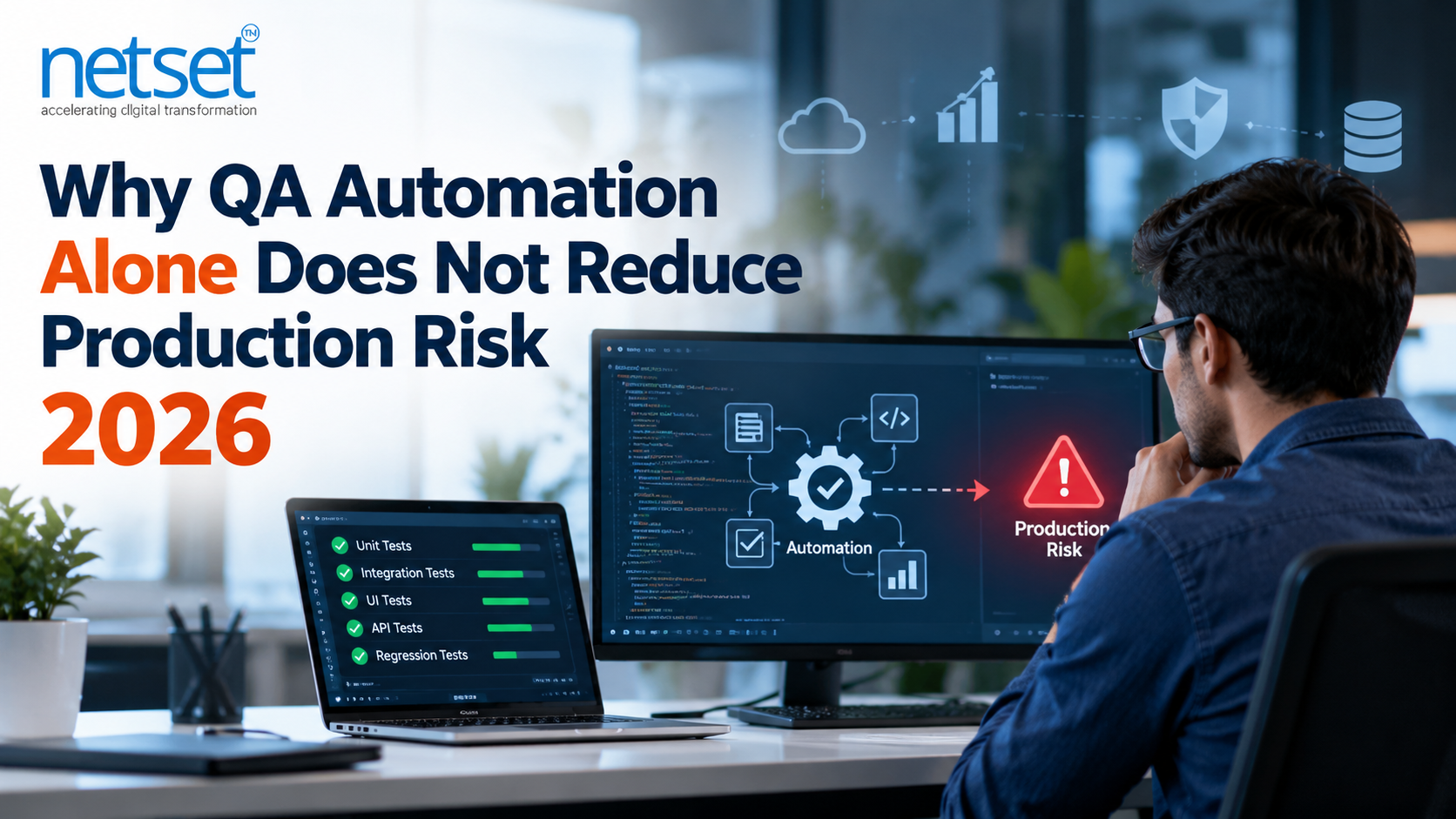
QA automation has become an essential part of modern software development. Automated tests can execute thousands of checks faster than manual testing, run repeatedly after every code change, and provide developers with rapid feedback. For teams working with frequent releases, automation is often necessary to maintain development speed without sacrificing basic quality.
But there is a common misconception: more automated tests automatically mean lower production risk.
They do not.
Automation can identify many defects, but production failures often come from problems that automated test suites were never designed to detect. Poor requirements, incomplete test coverage, infrastructure changes, security weaknesses, configuration errors, unreliable third-party services, data problems, and unexpected user behavior can all create production incidents even when an application has an impressive automation suite.
The real objective of QA is therefore not simply to automate testing. It is to build a top engineering process that identifies and controls risk throughout the software lifecycle.
What QA Automation Actually Solves
Automated testing is particularly effective when a team needs to repeatedly validate predictable application behavior.
Regression tests can confirm that existing functionality still works after a new feature is introduced. API tests can verify responses, authentication, data validation, and business rules. Unit tests can catch problems in individual components, while end-to-end tests can validate important user journeys.
Automation is also valuable for continuous integration and continuous delivery. Tests can run automatically when developers submit code, allowing teams to detect defects before they reach production.
The problem begins when organizations treat successful automated test execution as proof that the application is production-ready.
A test can only identify a problem when the test knows what to look for.
Test Coverage Is Not the Same as Risk Coverage
A development team may report 90% code coverage and still have custom production risks.
Code coverage generally tells you which portions of the code were executed during testing. It does not necessarily tell you whether the most important business scenarios were tested correctly.
Consider an e-commerce application. Automated tests may verify that a customer can successfully place an order. But what happens if inventory changes between payment authorization and order creation? What happens if the payment provider responds slowly? What happens when a customer's session expires during checkout?
These are risk scenarios rather than simple code paths.
This is why engineering teams need to think beyond test percentages and ask a more important question:
Which failures would have the greatest impact on customers or the business, and have we actually tested for them?
Requirements Problems Can Reach Production
Automation cannot compensate for unclear requirements.
If a product requirement is incomplete or misunderstood, developers may implement exactly what was specified while still delivering the wrong business outcome. Automated tests can then confirm that the implementation behaves according to the incorrect expectation.
This is one reason human involvement remains essential in quality engineering.
A QA Tester should not only execute test cases. The role can also involve challenging assumptions, identifying ambiguous requirements, understanding user workflows, evaluating edge cases, and communicating potential risks to developers and product teams.
The earlier these conversations happen, the cheaper it is to correct the problem.
Production Environments Are Different
One of the biggest limitations of automated testing is the difference between test environments and real production environments.
Production may have different:
- Database volumes
- Network conditions
- Traffic patterns
- Infrastructure configurations
- Authentication settings
- Third-party integrations
- User behavior
- Cloud resources
An application can pass every automated test in a controlled environment and still behave differently under real-world conditions.
Performance testing, load testing, observability, infrastructure validation, and controlled production releases therefore need to complement functional automation.
Third-Party Dependencies Create Additional Risk
Modern applications rarely operate independently.
A typical application may depend on payment gateways, authentication providers, cloud services, messaging platforms, mapping services, analytics systems, or external APIs.
Your automated tests may confirm that your application handles a normal API response correctly. They may not fully reproduce what happens when the external service becomes unavailable, changes its response structure, introduces latency, or reaches a rate limit.
Resilience testing can help address these scenarios.
Teams should consider how the application behaves when dependencies fail rather than testing only when everything works correctly.
Security Risk Requires More Than Functional Tests
Functional automation answers questions such as:
Does the feature work?
Security testing asks a different question:
Can someone misuse the feature?
An automated functional test may verify that a user can upload a document. It does not automatically determine whether an attacker can upload malicious content, access another user's document, bypass authorization, or exploit an API endpoint.
Security testing, dependency scanning, penetration testing, access-control validation, and secure coding practices should therefore exist alongside functional automation.
For organizations working with sensitive customer or business data, security cannot be treated as a final testing phase.
Data Problems Are Often Difficult to Automate
Production systems frequently contain messy, unexpected, or historically inconsistent data.
A test database is usually clean and predictable. Real production data may contain missing values, duplicate records, unusual characters, outdated records, incorrect relationships, or extremely large datasets.
This becomes particularly important during migrations and major application changes.
Before deployment, teams should validate migration scripts, database constraints, transformation logic, backup procedures, and rollback strategies. Automated testing can support these activities, but experienced engineers still need to evaluate whether the resulting data makes business sense.
Observability Continues Quality After Deployment
Quality assurance should not end when software reaches production.
Monitoring, logging, tracing, alerting, and application performance metrics provide visibility into what is actually happening after release.
A strong observability strategy can reveal issues that were impossible to reproduce in testing. For example, a feature may work correctly for most users while failing for a specific browser, geographic region, account type, or data condition.
This is why modern engineering teams increasingly combine automated testing with observability and production feedback.
The goal is not to prevent every possible failure. That is unrealistic. The goal is to detect important failures quickly and reduce their impact.
Reduce Risk Through Layered Quality Engineering
A safer approach is to create multiple layers of protection.
Unit tests provide fast feedback on individual components. Integration tests verify communication between services. API and end-to-end tests validate important workflows. Performance testing evaluates behavior under expected and unexpected loads. Security testing examines potential vulnerabilities.
Human exploratory testing then helps identify scenarios that were not anticipated during automation.
Finally, deployment controls such as feature flags, staged releases, canary deployments, automated rollback, monitoring, and incident response provide additional protection when software reaches real users.
Each layer addresses a different category of risk.
Where Development Capacity Fits In
Building this level of quality engineering requires experienced people as well as tools. Organizations with ongoing product development may hire dedicated developers who can work closely with QA, DevOps, product, and architecture teams.
For startups, the challenge is often even greater. Teams looking to hire top software developers for startups need engineers who understand that development and quality are connected rather than separate activities.
An experienced development partner can also provide additional engineering capacity when internal teams need help with automation, testing infrastructure, modernization, or release engineering.
For companies expanding their engineering operations internationally, build-operate-transfer IT outsourcing can provide another long-term model in which an engineering capability is established and operated before eventually transitioning to the client's organization.
Likewise, an Offshore software development service can provide access to engineering and QA expertise while allowing organizations to scale delivery according to project requirements.
The Real Goal Is Risk Reduction
QA automation remains one of the most valuable investments a software team can make. The mistake is expecting automation alone to solve every quality problem.
Production risk is influenced by requirements, architecture, code quality, infrastructure, security, data, integrations, deployment practices, and real-world user behavior.
The strongest engineering organizations therefore treat automation as one layer within a broader quality strategy.
NetSet Software helps businesses build and scale engineering capabilities across software development, QA, cloud, and modern technology environments, supporting teams that need quality to remain part of the development process rather than an afterthought.
Ultimately, the question should not be “How many automated tests do we have?”
A better question is:
“Do we understand our highest production risks, and have we built enough protection around them?”
That shift—from test volume to risk management—is what makes QA automation genuinely valuable.
FAQs
Does QA automation guarantee bug-free software?
No. Automation reduces the risk of known and repeatable defects, but it cannot guarantee that every production issue will be detected before release.
Why can software fail in production even when all automated tests pass?
Production has different traffic, data, infrastructure, configurations, integrations, and user behavior. These conditions may not be fully represented in automated test environments.
Is manual testing still necessary when automation is available?
Yes. Exploratory and human-led testing can uncover unexpected workflows, usability problems, ambiguous requirements, and scenarios that were not included in automated test cases.
What should a QA Tester focus on besides executing automated tests?
A QA Tester should understand business requirements, identify edge cases, assess risk, validate user workflows, investigate unexpected behavior, and work closely with developers and product teams.
How can teams reduce production risk beyond automated testing?
Teams should combine automation with security testing, performance testing, code reviews, observability, controlled deployments, infrastructure validation, data testing, and incident-response processes.
What is the difference between test coverage and risk coverage?
Test coverage measures how much of the application is exercised by tests. Risk coverage considers whether the tests address the failures that could have the greatest impact on users, revenue, security, or business operations.
When should production monitoring be part of the QA strategy?
Monitoring should be considered before deployment. Metrics, logs, traces, alerts, and release monitoring help teams detect issues that cannot always be reproduced in development or staging environments.

 English
 French
 Spanish
 Portuguese
 Deutsch
 Turkish
 Dutch
 Italiano
 Russian
 Romaian
 Portuguese (Brazil)
 Greek
