

Rare Earth Magnet Manufacturing Plant Cost: From Powder Processing to Magnet Manufacturing
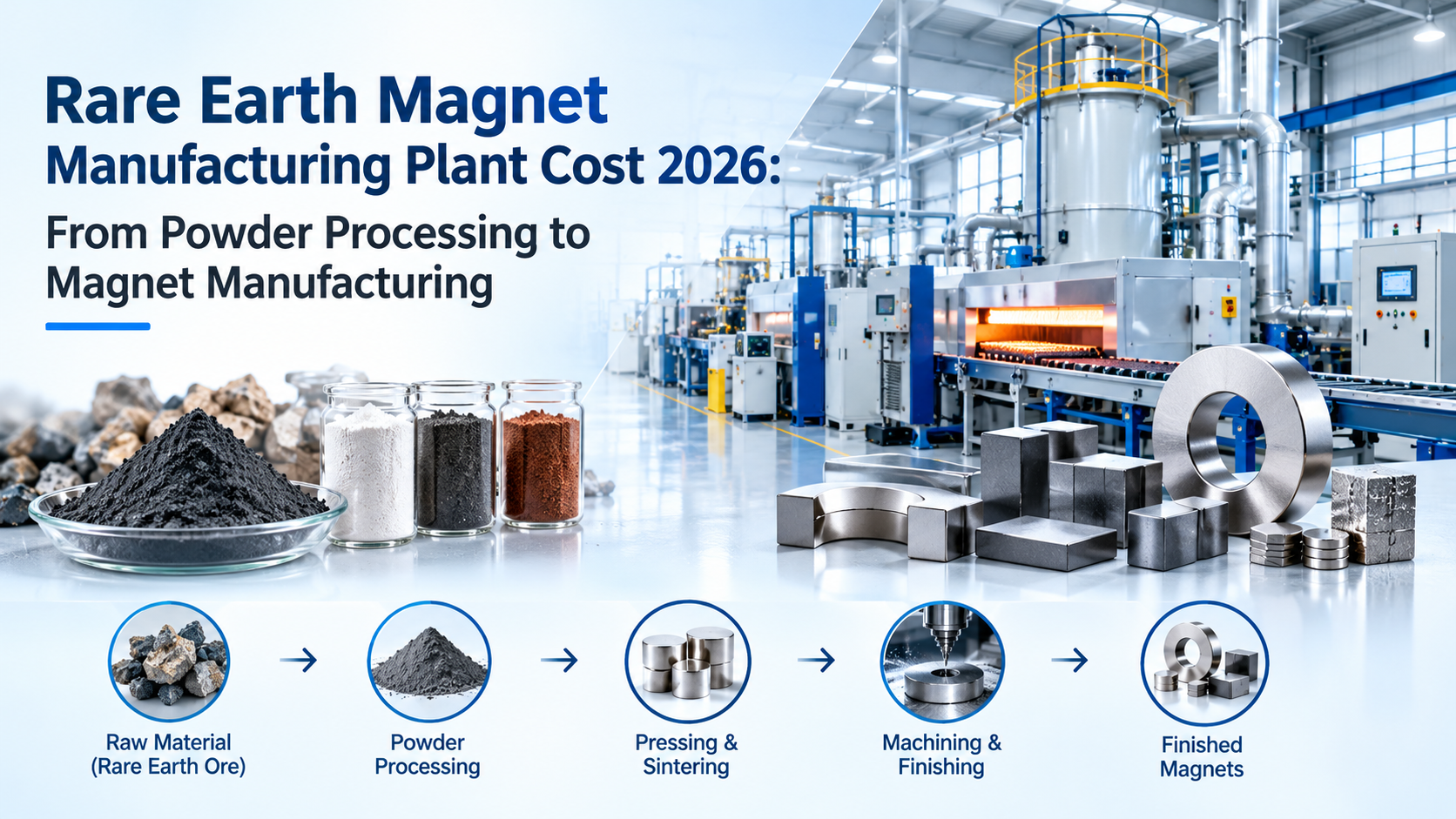
IMARC Group's report, "Rare Earth Magnet Manufacturing Plant Project Report 2026: Industry Trends, Plant Setup, Machinery, Raw Materials, Investment Opportunities, Cost and Revenue", offers a comprehensive guide for establishing a manufacturing plant. The rare earth magnet manufacturing plant setup report offers insights into the manufacturing process, financials, capital investment, expenses, ROI, and more for informed business decisions.
Rare Earth Magnet Manufacturing Plant Project Report Summary: -
- Comprehensive guide for setting up rare earth magnet manufacturing plant.
- Covers market trends and industry outlook for 2026.
- Detailed project setup, including unit operations and processes.
- Raw material and utility requirements.
- Infrastructure and machinery specifications.
- Workforce and staffing requirements.
- Packaging and transportation details.
- Financial aspects: investment opportunities, cost analysis, and revenue projections.
In addition to covering operational aspects, the report offers detailed insights into the rare earth magnet manufacturing plant process and project economics.
- Detailed insights into the rare earth magnet manufacturing plant
- In-depth project economics and financial metrics.
- Covers capital investments and project funding.
- Analysis of operating expenses and income projections.
- Breakdown of fixed and variable costs, direct and indirect expenses.
- Evaluation of ROI (Return on Investment) and NPV (Net Present Value).
- Profit and Loss account analysis.
- Comprehensive financial analysis for decision-making.
- Provides a roadmap for successfully establishing a rare earth magnet manufacturing plant.
Request for a Sample Report: https://www.imarcgroup.com/rare-earth-magnet-manufacturing-plant-project-report/requestsample
What is a rare earth magnet?
Rare earth magnets are powerful permanent magnets manufactured using alloys of rare earth elements, primarily neodymium, iron, and boron, or samarium and cobalt. These magnets are renowned for their exceptional magnetic strength, high energy density, and compact size, making them suitable for applications where efficient performance and space optimization are essential. Neodymium-iron-boron (NdFeB) magnets are widely used due to their superior magnetic properties and versatility, while samarium-cobalt magnets offer excellent thermal stability and corrosion resistance. Rare earth magnets play a crucial role in various industries, including automotive, renewable energy, electronics, aerospace, healthcare, and industrial machinery. They are extensively utilized in electric vehicle motors, wind turbine generators, hard disk drives, speakers, magnetic resonance imaging equipment, and precision instruments. The manufacturing process typically involves alloy preparation, powder processing, pressing, sintering, machining, coating, and magnetization. Their ability to deliver high torque, improve energy efficiency, and reduce equipment size has made rare earth magnets an important component in modern technologies and advanced industrial applications.
Market Trends and Drivers:
The rare earth magnet market is primarily driven by the growing adoption of electric vehicles, expanding renewable energy infrastructure, and increasing demand for energy-efficient electronic devices. Electric vehicle manufacturers rely on high-performance neodymium magnets for traction motors, while wind turbine producers utilize them in permanent magnet generators to improve power generation efficiency. The rising deployment of automation systems, robotics, industrial motors, and advanced manufacturing equipment is further strengthening product demand. Additionally, the growing use of consumer electronics, including smartphones, headphones, speakers, and computer storage devices, is contributing to market expansion. According to IMARC Group, the global rare earth magnet market was valued at USD 20.47 billion in 2025 and is expected to reach USD 31.76 billion by 2034, exhibiting a compound annual growth rate (CAGR) of 5.0% from 2026 to 2034.
Furthermore, increasing investments in clean energy technologies, electrification, and advanced defense systems are creating new growth opportunities. Government initiatives supporting electric mobility and renewable power generation are also encouraging industry development. However, fluctuations in rare earth element prices, supply chain vulnerabilities, environmental concerns associated with mining, and geopolitical uncertainties are prompting manufacturers to explore recycling, alternative materials, and diversified sourcing strategies to ensure long-term supply stability.
Rare Earth Magnet Manufacturing Process: From Alloying to Powder Preparation
The rare earth magnet manufacturing process involves several precision-driven stages, beginning with raw material preparation and progressing through alloying, powder processing, pressing, sintering, machining, and magnetization. According to IMARC Group, the key raw materials include neodymium, praseodymium, dysprosium, iron, and boron, which are processed to produce high-performance permanent magnets. The manufacturing workflow typically incorporates vacuum induction melting furnaces, jet milling units, isostatic pressing machines, sintering furnaces, and machining and grinding equipment. Careful control of material composition, particle size, processing conditions, and magnetic properties is essential for achieving the required product quality and performance. Quality assurance systems and technical testing are integrated throughout the production process to ensure consistency and compliance with application-specific requirements.
Powder Processing and Sintering for High-Performance Magnets
Powder processing and sintering are critical stages in rare earth magnet manufacturing, as they help establish the material structure and magnetic performance of the finished product. After alloy preparation, specialized milling equipment is used to produce fine powders suitable for subsequent forming operations. These powders are then compacted using appropriate pressing techniques and processed through controlled sintering to develop the required density and structural integrity. Subsequent machining, grinding, and finishing operations help achieve the specified dimensions and surface characteristics, while magnetization systems impart the desired magnetic properties. Selecting appropriate machinery, optimizing production parameters, and implementing rigorous quality checks can help manufacturers improve operational efficiency and reduce material wastage.
Machinery Requirements and Production Capacity for Magnet Manufacturing
Establishing a rare earth magnet manufacturing plant requires an integrated production setup with equipment suited to each stage of the manufacturing process. Major machinery requirements include high-purity material handling systems, vacuum induction melting furnaces, jet milling units, isostatic pressing machines, sintering furnaces, machining and grinding centers, magnetization systems, and quality control testing apparatus. According to IMARC Group, the proposed rare earth magnet manufacturing facility is designed for an annual production capacity of 500–2,000 metric tons. Plant layout optimization, reliable utilities, appropriate storage facilities, and efficient material handling are important considerations when planning the production line. The selection of machinery and technology should align with the intended capacity, product specifications, automation requirements, and investment objectives.
Raw Material Costs and Operational Efficiency in Magnet Production
Raw material procurement is a major consideration in the operating cost structure of a rare earth magnet manufacturing plant. IMARC Group estimates that raw materials account for approximately 60–70% of total operating expenditure (OpEx), while utilities contribute around 20–25%. The primary inputs include neodymium, praseodymium, dysprosium, iron, and boron. Consequently, securing dependable suppliers, negotiating long-term procurement agreements, and monitoring raw material price fluctuations are important for maintaining production continuity and managing costs. Manufacturers must also account for labor, equipment maintenance, energy consumption, packaging, transportation, and quality control. Efficient powder processing, optimized production workflows, and effective inventory management can support cost control while maintaining consistent magnet quality.
Ask Analyst for Customization: https://www.imarcgroup.com/request?type=report&id=7303&flag=C
Customization Options Available:
- Plant Location: Selection of optimal location for the plant.
- Plant Capacity: Customization based on desired production capacity.
- Machinery: Choice between automatic, semi-automatic, or manual machinery.
- List of Machinery Providers: Identification of suitable machinery suppliers.
Key Questions Addressed in This Report:
- How has the rare earth magnet market performed so far and how will it perform in the coming years?
- What is the market segmentation of the global rare earth magnet market?
- What is the regional breakup of the global rare earth magnet market?
- What are the price trends of various feedstocks in the rare earth magnet industry?
- What is the structure of the rare earth magnet industry and who are the key players?
- What are the various unit operations involved in a rare earth magnet manufacturing plant?
- What is the total size of land required for setting up a rare earth magnet manufacturing plant?
- What is the layout of a rare earth magnet manufacturing plant?
- What are the machinery requirements for setting up a rare earth magnet manufacturing plant?
- What are the raw material requirements for setting up a rare earth magnet manufacturing plant?
- And more...
How IMARC Can Help?
IMARC Group is a global management consulting firm that helps the world's most ambitious changemakers to create a lasting impact. The company provide a comprehensive suite of market entry and expansion services. IMARC offerings include thorough market assessment, feasibility studies, company incorporation assistance, factory setup support, regulatory approvals and licensing navigation, branding, marketing and sales strategies, competitive landscape and benchmarking analyses, pricing and cost research, and procurement research.
Services:
- Plant Setup
- Factoring Auditing
- Regulatory Approvals, and Licensing
- Company Incorporation
- Incubation Services
- Recruitment Services
- Marketing and Sales
Contact Us:
IMARC Group
134 N 4th St. Brooklyn, NY 11249, USA
Email: sales@imarcgroup.com
Tel No:(D) +91 120 433 0800
United States: +1-201971-6302

 English
 Arabic
 Spanish
 Portuguese
 Deutsch
 Turkish
 Dutch
 Italiano
 Russian
 Romaian
 Portuguese (Brazil)
 Greek
