

Energy Drink Manufacturing Plant Cost: Ingredients, Machinery, Utilities and Factory Requirements
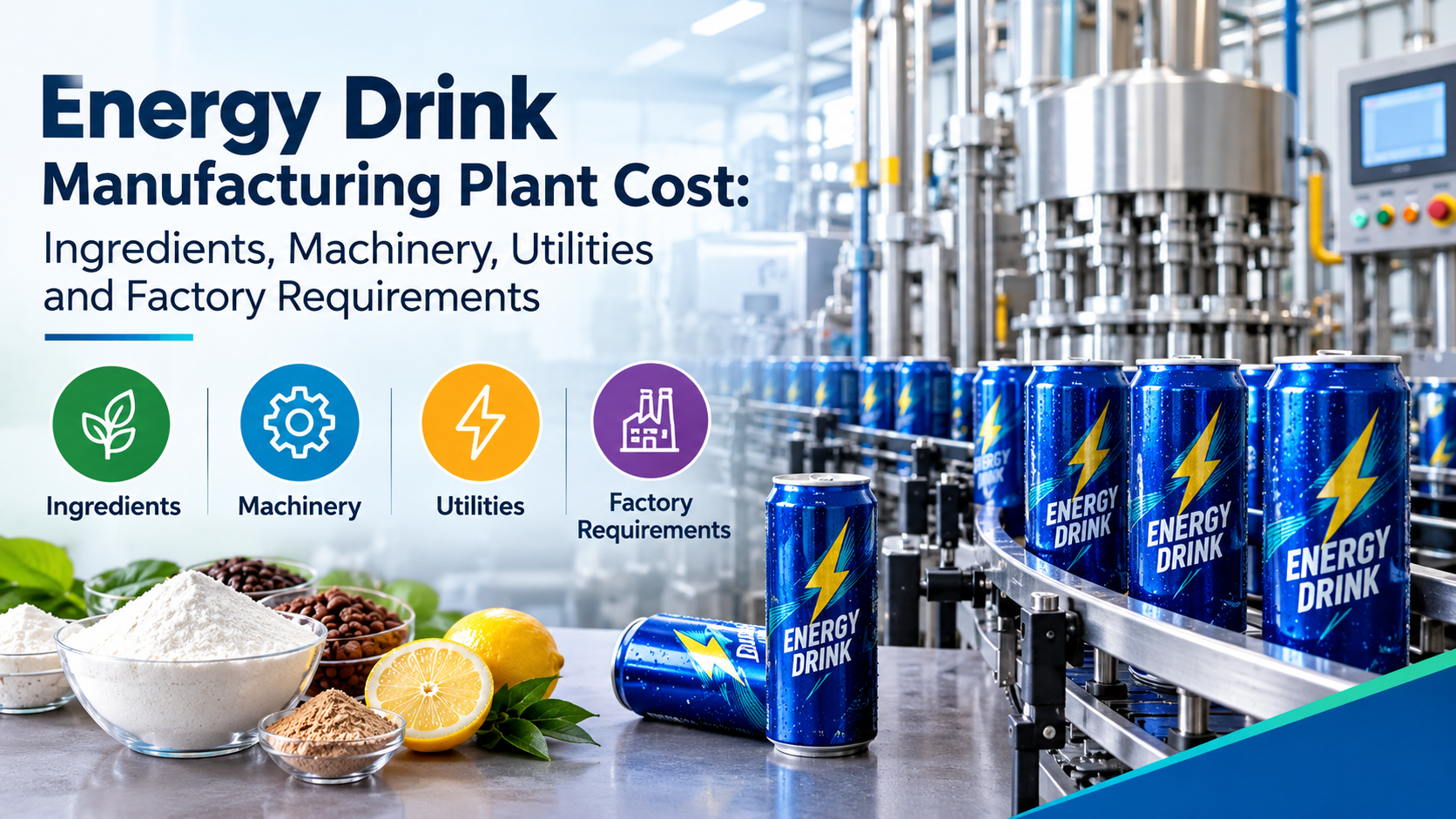
IMARC Group's report, "Energy Drink Manufacturing Plant Project Report 2026: Industry Trends, Plant Setup, Machinery, Raw Materials, Investment Opportunities, Cost and Revenue", offers a comprehensive guide for establishing a manufacturing plant. The energy drink manufacturing plant cost report offers insights into the manufacturing process, financials, capital investment, expenses, ROI, and more for informed business decisions.
Energy Drink Manufacturing Plant Project Report Summary: -
- Comprehensive guide for setting up an energy drink manufacturing plant.
- Covers market trends and industry outlook for 2026.
- Detailed project setup, including unit operations and processes.
- Raw material and utility requirements.
- Infrastructure and machinery specifications.
- Workforce and staffing requirements.
- Packaging and transportation details.
- Financial aspects: investment opportunities, cost analysis, and revenue projections.
In addition to covering operational aspects, the report offers detailed insights into the energy drink manufacturing plant process and project economics.
- Detailed insights into the energy drink manufacturing plant
- In-depth project economics and financial metrics.
- Covers capital investments and project funding.
- Analysis of operating expenses and income projections.
- Breakdown of fixed and variable costs, direct and indirect expenses.
- Evaluation of ROI (Return on Investment) and NPV (Net Present Value).
- Profit and Loss account analysis.
- Comprehensive financial analysis for decision-making.
- Provides a roadmap for successfully establishing an energy drink manufacturing plant.
Request for a Sample Report: https://www.imarcgroup.com/energy-drink-manufacturing-plant-project-report/requestsample
What is an energy drink?
Energy drinks are beverages formulated to provide a temporary boost in energy, alertness, and concentration. They typically contain caffeine, sugar or alternative sweeteners, B vitamins, taurine, and other functional ingredients that support their stimulating effects. Available in carbonated and non-carbonated varieties, these beverages cater to consumers seeking convenient options to maintain energy levels during work, study, exercise, and other demanding activities. Energy drinks are widely marketed to young adults, athletes, professionals, and individuals with active lifestyles. Manufacturers are increasingly introducing sugar-free, low-calorie, natural, and plant-based formulations to address evolving consumer preferences for healthier beverage alternatives. Additionally, innovations in flavor profiles, packaging formats, and ingredient combinations are expanding product differentiation and strengthening brand appeal. Energy drinks are distributed through supermarkets, convenience stores, online platforms, vending machines, and fitness centers, making them easily accessible to diverse consumer groups. Their convenience, portability, and association with active lifestyles continue to support their popularity across global beverage markets.
Market Trends and Drivers:
The global energy drink market is primarily driven by the growing demand for convenient beverages that support alertness, concentration, and active lifestyles. Increasing work-related pressures, busy schedules, and rising participation in sports and fitness activities are encouraging consumers to incorporate energy drinks into their daily routines. The global energy drink market size was valued at USD 50.81 Billion in 2025. According to IMARC Group estimates, the market is expected to reach USD 83.26 Billion by 2034, exhibiting a CAGR of 5.64% from 2026 to 2034. This growth is further supported by continuous product innovation, including sugar-free formulations, reduced-calorie beverages, functional ingredients, and distinctive flavor combinations that appeal to health-conscious consumers.
Moreover, aggressive marketing campaigns, celebrity endorsements, sports sponsorships, and social media promotions are improving brand visibility and expanding consumer engagement. The rapid growth of e-commerce and organized retail is also enhancing product accessibility across urban and emerging markets. Additionally, manufacturers are investing in attractive packaging, convenient can formats, and premium product positioning to differentiate their offerings. Growing interest in functional beverages and the expansion of distribution networks are expected to create further opportunities for energy drink manufacturers worldwide.
Essential Raw Materials and Ingredients for Energy Drink Production
Setting up an energy drink manufacturing plant requires a consistent supply of high-quality ingredients to ensure product taste, formulation accuracy, and quality. According to IMARC Group, the primary raw materials include water, caffeine, taurine, B vitamins, sweeteners, and flavouring agents. Additional ingredients may include herbal extracts such as guarana and ginseng, colourants, acidity regulators such as citric acid, and preservatives, depending on the product formulation. Packaging materials, including cans and bottles, are also essential for finished product storage and distribution. Establishing reliable procurement channels and maintaining appropriate storage conditions help manufacturers manage ingredient quality, ensure uninterrupted production, and maintain consistency across batches.
Machinery and Equipment Required for Energy Drink Manufacturing
The machinery requirements for an energy drink manufacturing plant depend on production capacity, formulation specifications, and the desired level of automation. Key equipment includes water purification systems, ingredient mixing and blending tanks, filtration systems, carbonation units, pasteurizers, filling machines, capping equipment, labelling machines, and packaging lines. Storage tanks and quality control testing instruments are also required to support material handling and product inspection. The manufacturing process involves ingredient preparation, water treatment, formulation and mixing, carbonation where applicable, pasteurization, filling, sealing, labelling, and packaging. Selecting suitable machinery helps improve production efficiency, maintain formulation consistency, reduce material wastage, and support compliance with applicable food safety and quality standards.
Utility Requirements for an Energy Drink Manufacturing Facility
Utilities form an essential part of energy drink manufacturing, supporting production, sanitation, equipment operation, and product quality management. The facility requires a reliable water supply for beverage formulation, ingredient preparation, and cleaning operations. Electricity is necessary to operate processing machinery, water treatment systems, filling lines, packaging equipment, and laboratory instruments. Depending on the production technology, additional utility requirements may include steam, hot water, compressed air, and cooling systems. According to IMARC Group, utilities account for approximately 10–15% of total operating expenditure (OpEx) in an energy drink manufacturing plant. Efficient utility management, preventive maintenance, and appropriate water treatment and waste management systems can help control operating costs while maintaining hygienic and reliable manufacturing operations.
Factory Infrastructure, Layout and Space Requirements
Establishing an energy drink manufacturing facility requires careful planning of the site, production layout, storage areas, and supporting infrastructure. The selected location should provide access to essential raw materials, packaging supplies, transportation networks, reliable utilities, and target markets. The factory layout should include designated areas for raw material receiving and storage, water treatment, ingredient preparation, mixing, carbonation, processing, filling, packaging, quality control, and finished goods storage. Adequate space should also be allocated for equipment installation, material movement, employee facilities, maintenance activities, and future expansion. The facility must incorporate appropriate hygiene controls, drainage, waste management, and safety systems. Compliance with applicable zoning, environmental, factory licensing, and food safety requirements is also necessary for establishing an efficient and operationally compliant energy drink manufacturing plant.
Ask Analyst for Customization: https://www.imarcgroup.com/request?type=report&id=9778&flag=C
Customization Options Available:
- Plant Location: Selection of optimal location for the plant.
- Plant Capacity: Customization based on desired production capacity.
- Machinery: Choice between automatic, semi-automatic, or manual machinery.
- List of Machinery Providers: Identification of suitable machinery suppliers.
Key Questions Addressed in This Report:
- How has the energy drink market performed so far and how will it perform in the coming years?
- What is the market segmentation of the global energy drink market?
- What is the regional breakup of the global energy drink market?
- What are the price trends of various feedstocks in the energy drink industry?
- What is the structure of the energy drink industry and who are the key players?
- What are the various unit operations involved in an energy drink manufacturing plant?
- What is the total size of land required for setting up an energy drink manufacturing plant?
- What is the layout of an energy drink manufacturing plant?
- What are the machinery requirements for setting up an energy drink manufacturing plant?
- What are the raw material requirements for setting up an energy drink manufacturing plant?
- And more...
How IMARC Can Help?
IMARC Group is a global management consulting firm that helps the world's most ambitious changemakers to create a lasting impact. The company provide a comprehensive suite of market entry and expansion services. IMARC offerings include thorough market assessment, feasibility studies, company incorporation assistance, factory setup support, regulatory approvals and licensing navigation, branding, marketing and sales strategies, competitive landscape and benchmarking analyses, pricing and cost research, and procurement research.
Services:
- Plant Setup
- Factoring Auditing
- Regulatory Approvals, and Licensing
- Company Incorporation
- Incubation Services
- Recruitment Services
- Marketing and Sales
Contact Us:
IMARC Group
134 N 4th St. Brooklyn, NY 11249, USA
Email: sales@imarcgroup.com
Tel No:(D) +91 120 433 0800
United States: +1-201971-6302

 English
 Arabic
 French
 Spanish
 Portuguese
 Deutsch
 Turkish
 Italiano
 Russian
 Romaian
 Portuguese (Brazil)
 Greek
