

Traveling With a Luxury Watch: Smart Habits for Airports, Hotels, and International Trips
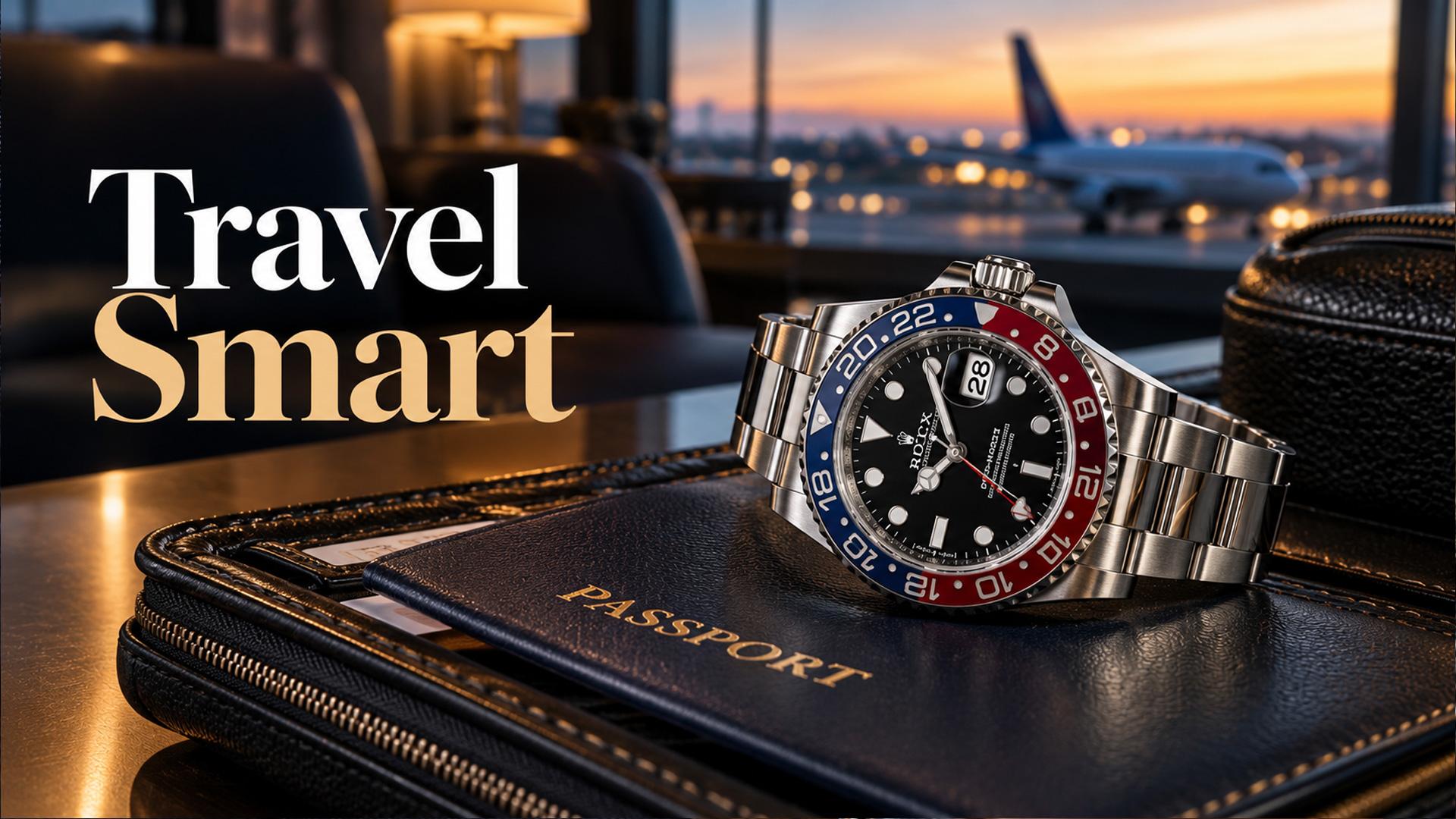
Before You Pack That Rolex or Patek Philippe, Learn the Travel Habits That Can Save You Trouble
A luxury watch can be particularly enjoyable when traveling. It may accompany you to an important conference, a family celebration, or a long-awaited vacation. A familiar watch also brings a small sense of routine when everything around you is changing.
But travel introduces decisions that seldom matter when the watch is sitting safely at home.
Should it go in your carry-on bag? What happens at airport security? Is it worth bringing a second watch? Will your insurance cover the trip? And if you buy another watch abroad, what documentation should you keep?
Understanding the practical side of traveling with a luxury watch can reduce unnecessary risk and make the experience more enjoyable.
You do not need to treat every journey like a high-security operation. A few sensible habits, combined with knowledge of the watch and its intended use, can make a meaningful difference.
1. Decide Whether the Watch Actually Belongs on This Trip
The first decision should happen before packing.
Consider where you are going, what you will be doing, and whether the watch is suitable for those activities.
A comfortable steel sports watch may fit naturally into a trip involving meetings, sightseeing, and casual dinners. A delicate older watch with uncertain water resistance may be less suitable for a beach vacation or activities involving repeated impacts.
The most expensive watch you own is not automatically the best travel companion.
Ask yourself three questions:
-
Will I wear this watch often enough to justify bringing it?
-
Is its condition appropriate for the activities planned?
-
Can I store and protect it responsibly throughout the journey?
If the answer to the final question is uncertain, taking a different watch may be the more enjoyable choice.
2. Keep Valuable Watches in Your Carry-On, Not Checked Luggage
For air travel, valuable watches and jewelry are generally better kept in your personal possession rather than packed in checked baggage.
The U.S. Transportation Security Administration specifically advises travelers carrying valuable jewelry to keep those items with them and not place them in checked baggage.
That recommendation is sensible because checked bags can be delayed, damaged, or separated from their owners during a journey.
If you remove a watch for screening, make sure you understand where it is and retrieve it promptly. Follow instructions from the screening officer, since procedures can vary depending on the checkpoint and security requirements.
The Simple Carry-On Rule
Choose one secure place for your watch when it is not being worn. A protective travel case inside a bag that remains under your control is generally more sensible than leaving a valuable watch loose in an outside pocket.
A watch roll or travel pouch should protect the case and bracelet from rubbing against each other.
Avoid putting a watch in a compartment alongside keys, metal accessories, or other hard objects that could cause surface damage.
3. Consider Whether You Really Need a Second Watch
Some travelers enjoy bringing separate watches for business meetings, evening events, and leisure activities.
There is nothing wrong with that preference, but every additional watch introduces another valuable item to account for.
If your trip involves frequent hotel changes, busy transport connections, or limited secure storage, carrying one versatile watch may be simpler.
A carefully selected everyday watch can accompany professional and casual occasions without requiring a separate piece for each outfit.
For owners who travel regularly, this is a good reason to value comfort, reliable time reading, appropriate construction, and a design that works with different clothing.
4. Understand Your Insurance Before Leaving Home
A watch insured at your residence may not necessarily have the same protection in every travel situation.
Coverage depends on the insurer and the actual policy.
Some policies may distinguish theft, accidental damage, loss, unexplained disappearance, or international travel. Others may impose limits, deductibles, or documentation requirements.
Before departure, ask your insurance provider whether the watch is covered at your destination and during the activities you are planning.
Five Questions Worth Asking
-
Does my policy cover the watch outside the United States?
-
Is theft from a hotel room covered, and under what conditions?
-
What happens if the watch is accidentally lost?
-
Does the policy require proof of value or an updated appraisal?
-
What records would I need if I had to make a claim?
Keep appropriate purchase and insurance documentation in a secure location, with a protected digital copy available when genuinely needed.
A photograph of the watch can be helpful for records, but it does not replace proof of ownership or the documentation required by an insurer.
5. A GMT Watch Can Be Useful—But Learn How It Works Before Traveling
A watch with a second-time-zone function can be particularly appealing to frequent international travelers.
For example, the Rolex GMT-Master II features an additional 24-hour hand and a graduated bezel that allow the wearer to follow a second time zone alongside local time.
On appropriate GMT-Master II references, the conventional local-hour hand can be adjusted independently, making it convenient to update local time after arriving at a new destination.
That functionality can be useful for travelers coordinating calls or keeping track of the time at home.
However, different GMT watches use different setting mechanisms. Not every watch advertised as a GMT operates in exactly the same way.
Before departure, read the appropriate user instructions for your particular reference and practice setting the watch.
Travelers interested in comparing different watch functions can review Rolex watch references through Platinum Times Co. USA and enquire about the configuration of a specific listing.
6. Hotel Storage Requires Common Sense
A hotel room can feel secure, but that feeling should not replace sensible precautions.
If you choose not to wear your watch during an activity, consider what secure storage arrangements are actually available.
A room safe may be convenient, but its presence does not automatically make it suitable for every high-value item or guarantee coverage under an insurance policy.
For particularly valuable pieces, ask the property about secure storage arrangements and assess the risks before leaving the watch unattended.
Do not assume that every hotel has the same procedures, liability terms, or storage facilities.
If the watch remains with you, use a protective case and avoid placing it casually on surfaces where it can be knocked over, misplaced, or forgotten.
7. Be Careful Around Water, Sand, and Sudden Impacts
A watch's published water-resistance specification is an important technical characteristic, but it does not establish the current condition of every individual watch.
Seals can deteriorate, crowns can be damaged, and older watches may no longer perform to their original water-resistance specifications without inspection.
Before swimming or exposing a watch to substantial moisture, follow the manufacturer's guidance and make sure its current condition is appropriate.
Some watches are designed for particular water activities. Others are not.
Sand, repeated impacts, and contact with hard surfaces can also damage case finishing, crystals, bezels, or bracelets.
Beach vacations are not the ideal time to test whether an older watch is as robust as its reputation suggests.
8. Avoid Unnecessary Attention Without Giving Up Your Personal Style
Luxury-watch owners naturally enjoy wearing their watches. Traveling should not require abandoning that enjoyment.
However, situational awareness matters.
In crowded places, on public transportation, or during late-night activities, consider whether a highly recognizable watch attracts unnecessary attention.
Keep valuable possessions secure, follow local safety guidance, and avoid discussing the value of your watch with strangers.
If you feel uncomfortable in a particular situation, choosing not to wear a valuable watch is a reasonable decision.
The purpose is to travel comfortably, not to make watch ownership another source of anxiety.
9. Buying a Luxury Watch Abroad? Keep Your Documentation
Purchasing a watch while traveling internationally introduces additional questions.
A watch bought abroad may be subject to U.S. customs declaration requirements when entering the United States. The actual duties, exemptions, and treatment depend on the circumstances of the purchase and applicable rules.
Do not assume that wearing a newly purchased watch automatically removes declaration obligations.
Retain invoices, purchase documentation, and relevant identification details, and consult current U.S. Customs and Border Protection guidance before traveling.
If you are taking an expensive watch you already own out of the country and returning with it, proof of prior ownership may help distinguish it from a newly acquired purchase.
Customs and insurance documentation serve different purposes, so keep the relevant records organized.
10. Inspect Your Watch After Returning Home
Travel is a useful opportunity to notice how a watch performs during regular use.
After returning, inspect the bracelet, clasp, crystal, case, and general operation for anything unusual.
If the watch has been exposed to moisture or significant impact, seek appropriate professional guidance when needed.
Clean the watch only according to the manufacturer's instructions and its current condition.
A short inspection is a sensible habit, especially for watches that accompany you on frequent trips.
A Practical Luxury Watch Travel Checklist
|
Before Traveling |
During the Trip |
After Returning |
|---|---|---|
|
Check the watch's condition |
Keep valuables under control |
Inspect for visible damage |
|
Review insurance coverage |
Use appropriate storage |
Review any unusual operation |
|
Prepare a protective case |
Follow airport procedures |
Store documentation securely |
|
Understand its time-zone functions |
Avoid unsuitable activities |
Clean according to instructions |
|
Organize relevant ownership records |
Retain any overseas purchase documents |
Address maintenance concerns |
Frequently Asked Questions About Traveling With Luxury Watches
Should I put my Rolex in checked luggage?
Keeping valuable watches in your personal possession is generally the better approach. TSA specifically advises travelers not to pack valuable jewelry in checked baggage.
Can I wear a luxury watch through airport security?
Security procedures can vary. Follow the screening officer's instructions, and keep track of the watch if you are asked to remove it.
Is a GMT watch necessary for international travel?
No. A GMT function can be convenient for viewing multiple time zones, but many travelers manage perfectly well without one.
Does watch insurance automatically cover international travel?
No. Coverage depends on the actual policy, insurer, destination, and circumstances. Confirm the terms before departure.
Do I have to declare a watch purchased abroad?
Purchases made abroad can be subject to customs declaration requirements. Check current U.S. Customs and Border Protection rules for the circumstances of your trip.
Can I swim with a pre-owned luxury watch?
Only when the model is suitable for the activity and its current water-resistance condition is appropriate. An original specification alone does not establish the condition of an older watch.
Final Thoughts: The Best Travel Watch Is One You Can Enjoy Responsibly
A luxury watch can be a wonderful travel companion, especially when its design and functions fit the journey.
But enjoyable ownership also involves preparation. Knowing how to handle airport screening, storage, insurance, water exposure, and international purchases can help you avoid unnecessary problems.
Choose the watch that suits your itinerary, understand its features, and protect it in ways appropriate to its value and condition.
If you are considering a watch specifically for frequent travel, ask Platinum Times Co. USA about the exact reference, available condition information, and functions of a watch you're researching before making a purchase.

 English
 Arabic
 French
 Portuguese
 Deutsch
 Turkish
 Dutch
 Italiano
 Russian
 Romaian
 Portuguese (Brazil)
 Greek
