

Why Indonesian Buyers Should Evaluate Non-Stick Bipolar Forceps Beyond the Tip Finish
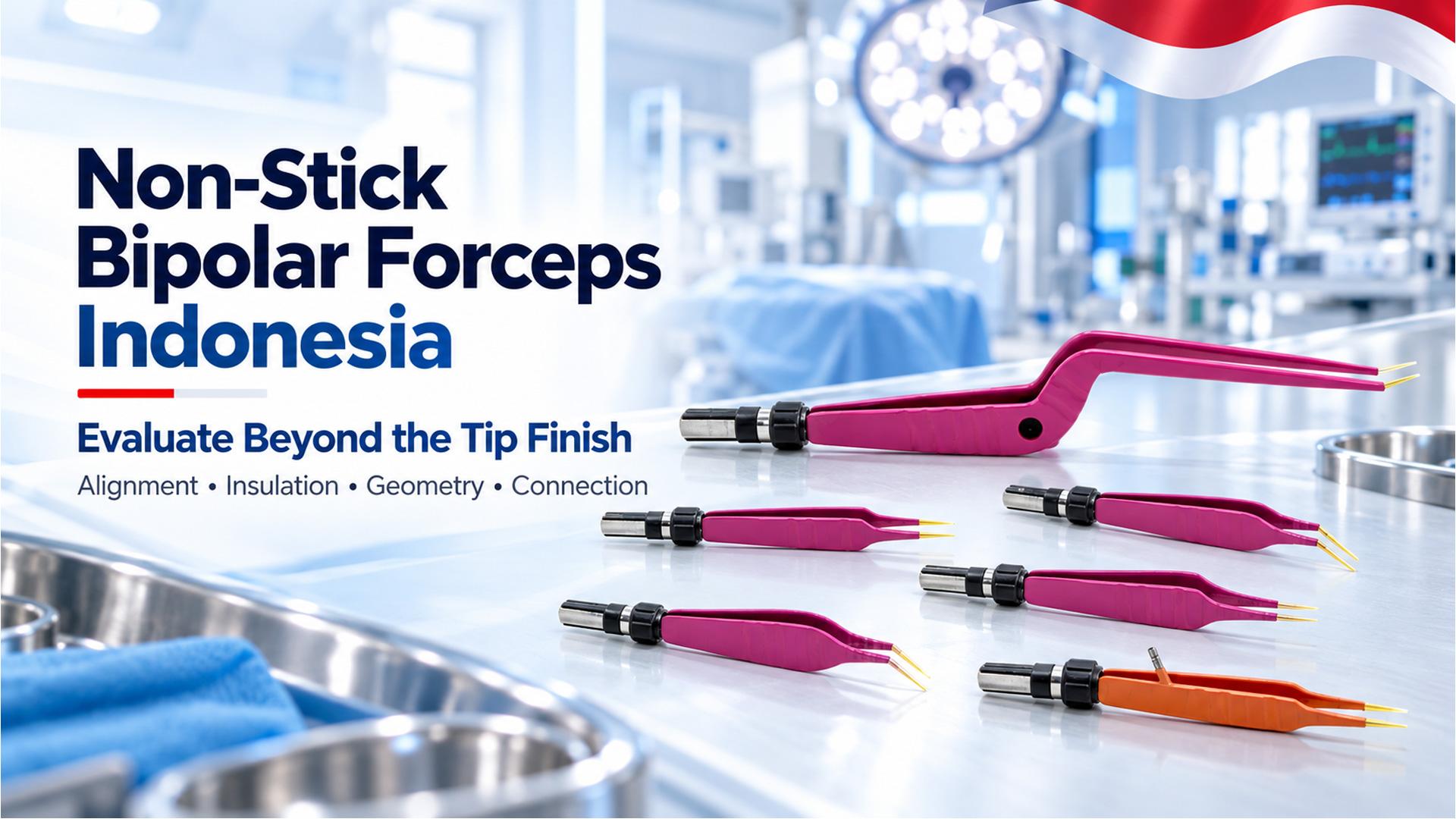
A Premium-Looking Tip Does Not Tell You Whether the Entire Instrument Will Perform Consistently
When buyers evaluate Non-Stick Bipolar Forceps, attention naturally goes to the working tips.
That makes sense. Non-stick performance is one of the defining reasons these forceps are selected.
But for Indonesian hospitals, medical distributors and OEM buyers, the tip finish is only one part of a much larger purchasing decision.
The overall instrument also depends on alignment, closing pressure, insulation, connector construction, instrument geometry, handling balance and repeat manufacturing consistency.
A product can look convincing in a photograph and still fail to match the approved specification where it matters.
Non-Stick Should Be Evaluated as a Complete Instrument Property
Different manufacturers may use specialised materials, surface treatments, alloys, plating or other engineering approaches to support reduced tissue adhesion at the working tips.
The important point for buyers is that appearance alone does not establish identical performance.
A gold-coloured tip, for example, does not automatically mean that two forceps share:
-
the same underlying material;
-
the same surface construction;
-
the same tip geometry;
-
the same insulation;
-
or the same manufacturing controls.
Professional buyers should therefore request product-specific information for the exact article being evaluated.
Tip Geometry Matters as Much as Tip Finish
Tip width, length, profile and working surface can change how the instrument handles tissue.
Small dimensional changes may be difficult to see in a catalogue image but can be obvious during physical assessment.
A quotation or specification should therefore identify more than the broad forceps pattern.
Useful details include:
-
overall length;
-
tip width;
-
tip length;
-
straight or angled configuration;
-
distal-tip profile;
-
and relevant working dimensions.
A supplier should be able to connect the quoted article number with these details.
Alignment Should Be Checked Before Approval
Bipolar forceps rely on two opposing tines meeting predictably.
Poor alignment can undermine the value of an otherwise attractive tip finish.
During sample review, buyers should inspect how the tips meet:
-
at rest;
-
during closure;
-
across the working surface;
-
and after relevant handling or reusable processing conditions where applicable.
Alignment should not be treated as a one-time sample issue either.
For distributors, repeat consistency becomes important because later production should remain comparable with the originally approved product.
Closing Pressure Influences Handling
Two forceps with similar dimensions can feel very different in use.
Spring tension, closing resistance and balance affect how the instrument handles.
Excessive or uneven closing pressure can change the feel of the instrument even if the tips themselves appear acceptable.
That is why physical sample evaluation remains important.
A catalogue photograph cannot communicate closing action or grip feel.
Insulation Is Part of the Instrument Specification
Insulation coverage should be reviewed along the tines and around relevant transitions.
For reusable products, buyers should also follow the manufacturer's applicable inspection and reprocessing information throughout the instrument's intended service life.
Damage, inconsistency or changes in insulation should not be ignored simply because the tips still appear visually acceptable.
Connector Compatibility Must Be Confirmed
The forceps also need to connect to the intended bipolar cable and electrosurgical system.
That means buyers should confirm:
-
connector type;
-
compatible bipolar cable;
-
generator-side system;
-
reusable or single-use status;
-
and any relevant product-specific instructions.
A compatible-looking connector is not enough.
The exact product reference should be approved as part of the complete system.
For buyers building a wider portfolio, Electro Range's Indonesia-focused electrosurgical information is available at:
https://electrorange.com/electrosurgical-instruments-indonesia/
Pattern Names Do Not Guarantee Identical Dimensions
Terms such as:
-
straight;
-
bayonet;
-
Adson;
-
Jeweller;
-
McPherson;
-
irrigation;
help describe instrument families.
But they should not be used as substitutes for exact dimensions.
Two manufacturers may use the same pattern name while supplying different:
-
lengths;
-
tip widths;
-
offsets;
-
angles;
-
handle profiles;
-
or connector arrangements.
Indonesian distributors should therefore avoid assuming equivalence based only on the product family name.
Straight and Bayonet Configurations Serve Different Requirements
Straight forceps provide a direct instrument profile.
Bayonet forceps use an offset design.
Within those broad categories, additional tip angles and dimensions may be available.
The correct selection should depend on the intended requirement, not simply on which pattern looks more specialised.
Irrigation Forceps Require Additional Review
Where irrigation is integrated into a bipolar forceps design, the purchasing specification becomes even more detailed.
Buyers may need to review:
-
the bipolar instrument geometry;
-
irrigation pathway;
-
irrigation connection;
-
cleaning requirements;
-
compatible accessories;
-
and intended use.
The irrigation component should not be treated as an optional detail after the forceps have already been approved.
Reusable and Single-Use Non-Stick Options Need Different Supply Planning
Non-stick forceps may be available in reusable and sterile single-use configurations.
Each creates a different procurement workflow.
Reusable models may require:
-
approved cleaning procedures;
-
inspection;
-
sterilisation;
-
service-life management;
-
cable compatibility;
-
and replacement planning.
Single-use models may require:
-
sterile packaging;
-
shelf-life control;
-
traceability;
-
stock rotation;
-
ongoing inventory;
-
and repeat supply planning.
Neither format is automatically better for every buyer.
The appropriate choice depends on the intended workflow and supply programme.
Batch-to-Batch Consistency Matters to Distributors
A sample can be excellent and still fail to represent future supply if production control is inconsistent.
This matters especially for distributors building long-term customer relationships.
Repeat orders should remain comparable in areas such as:
-
tip finish;
-
alignment;
-
closing action;
-
dimensions;
-
insulation;
-
connector construction;
-
and article identification.
An approved sample should therefore be connected to a controlled specification rather than treated as an isolated example.
Questions Indonesian Buyers Should Ask Before Approval
A strong enquiry can include:
-
Which tip material or surface construction supports the non-stick design?
-
Which forceps patterns are available?
-
What lengths and tip dimensions are offered?
-
How is tine alignment controlled?
-
What closing pressure should buyers expect?
-
Which connector is used?
-
Which bipolar cables and generators are compatible?
-
Is the forceps reusable or single-use?
-
Which reprocessing information applies?
-
Can repeat production be maintained against the approved specification?
These questions create a more useful supplier discussion than asking only whether the forceps are “non-stick.”
Final Thoughts
For Indonesian hospitals, distributors and OEM buyers, Non-Stick Bipolar Forceps should be evaluated as complete instruments.
Tip finish matters, but so do:
-
geometry;
-
alignment;
-
closing action;
-
insulation;
-
connector design;
-
handling;
-
and repeat consistency.
The strongest procurement decision is not based on what looks premium in a product image.
It is based on whether the complete forceps configuration remains technically suitable and commercially consistent across repeat supply.
Discuss non-stick bipolar forceps patterns, dimensions, connector requirements and repeat-supply specifications with Electro Range before product approval.

 English
 Arabic
 French
 Spanish
 Portuguese
 Deutsch
 Turkish
 Italiano
 Russian
 Romaian
 Portuguese (Brazil)
 Greek
