

eCommerce Category Page SEO Content: How to Write Copy That Ranks and Converts
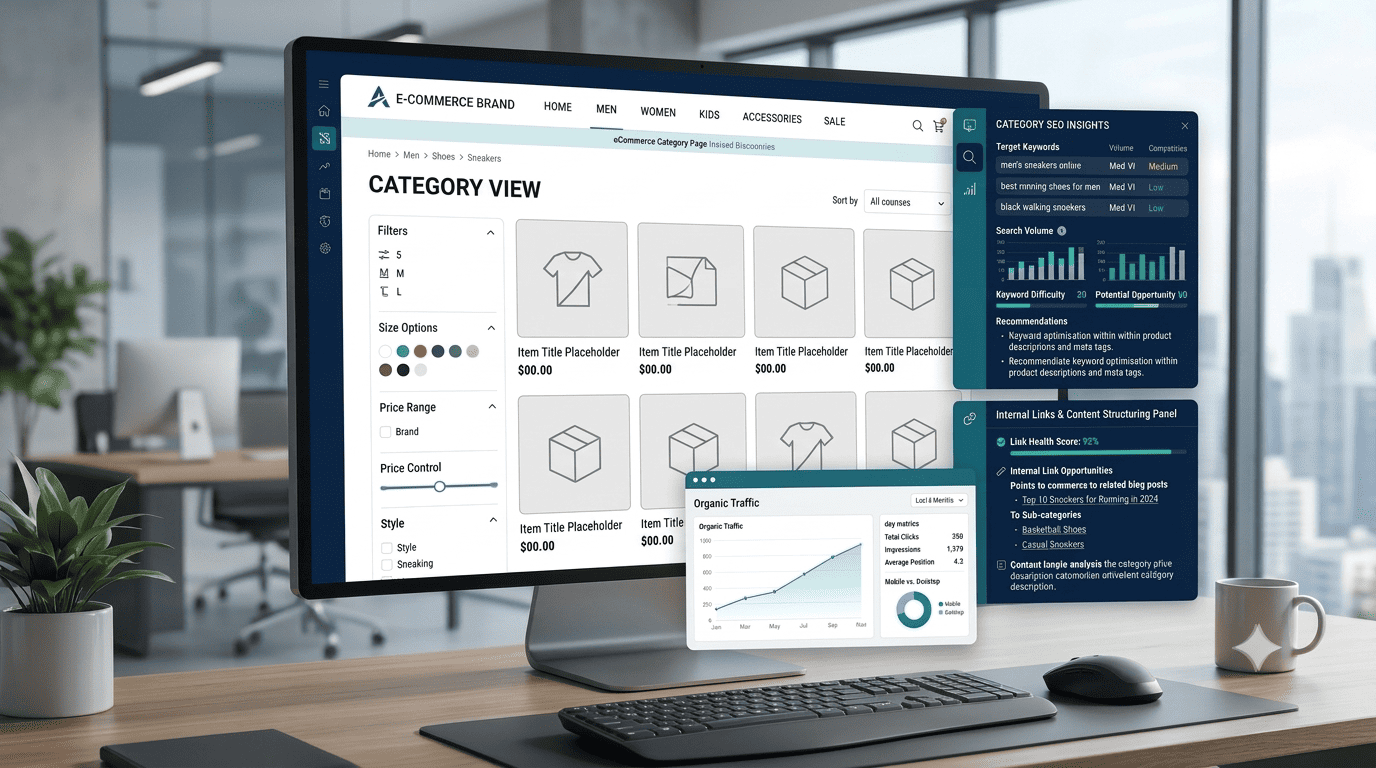
- Effective eCommerce category page SEO content uses 100–300 words of copy, a product grid above the fold, and one primary keyword plus 3–5 related terms.
- Place a 40–60 word intro above products and deeper buying guidance below them.
- Target commercial-intent keywords such as "women's running shoes," not informational queries.
- Measure the success of your eCommerce category page SEO content by category revenue and click-through rate, not word count.
What Is the Ideal Structure for eCommerce Category Page SEO Content?
The ideal structure for eCommerce category page SEO content puts products first and copy second. Shoppers arrive with buying intent, so the product grid must appear without scrolling, while a short intro and a lower content block give search engines the context they need to rank the page.
- H1: the primary category keyword, written naturally.
- Intro (40–60 words): states what the category offers and names one differentiator such as free returns or sizing range.
- Product grid: 24–48 items with descriptive filters and sort options.
- Buying guide (150–250 words): covers selection criteria, materials, or compatibility.
- FAQ block: 2–4 questions drawn from customer service and search data.
- Internal links: to subcategories and top sellers.
Keyword Strategy for eCommerce Category Page SEO Content
Assign one primary keyword per category and never share it with another page. Overlap creates cannibalization, where two URLs compete and both lose position.
Choose the primary term from commercial-intent queries with clear product demand. Then add 3–5 secondary terms: synonyms, subcategory names, and modifiers such as "waterproof" or "organic." Place the primary keyword in the title tag, H1, intro, and one subheading. Use secondary terms in the lower guide and in anchor text to child categories.
Check the live results before committing. If Google shows mostly product grids for a query, the category page is the right target. If it shows articles, write a guide instead and link it to the category.
Ranking Copy vs Converting Copy: 5 Differences
ElementWritten for RankingWritten for ConvertingPositionBelow the gridShort intro above the gridLength150–300 words40–60 wordsFocusKeyword variants and entitiesBenefits, shipping, returnsLinksSubcategories with keyword anchorsBest sellers and sale itemsSuccess metricImpressions and positionAdd-to-cart rate and revenue
The strongest eCommerce category page SEO content combines both columns. The intro persuades, and the lower block earns the ranking.
Optimizing the Elements Around the Copy
Copy alone does not carry a category page. Write title tags under 60 characters that include the keyword and a value cue, such as "Standing Desks: Free Shipping Over $99." Write meta descriptions of 140–155 characters with a clear call to action.
Add breadcrumbs with BreadcrumbList markup, and keep product names and image alt text descriptive. Google's documentation on breadcrumb structured data explains the required properties. Page speed also affects conversion: keep product images lazy-loaded below the first row so the grid renders quickly.
Refresh your eCommerce category page SEO content at least twice a year in 2026. Update seasonal terms, discontinued items, and new subcategories so the copy stays accurate.
Conclusion
Category pages earn revenue when copy supports the shopper instead of blocking the products. Genius eCommerce, an agency focused exclusively on BigCommerce, Shopify, Magento, and Volusion stores, applies this layered approach to eCommerce category page SEO content, helping mid-market retailers match search intent with purchase intent on every category.
eCommerce Category Page SEO Content FAQ
How many words should eCommerce category page SEO content have?
Use 100–300 words total. Keep 40–60 words above the product grid and place the remaining copy below it. Competitive categories can extend to 400 words if every sentence helps a buyer decide.
Should category copy go above or below the products?
Use both. A brief intro above the grid sets context without pushing products down, while the longer buying guide below supports rankings and answers pre-purchase questions.
Can one category page target multiple keywords?
Yes, if they share the same intent. Target one primary keyword and 3–5 close variants. Create a separate subcategory when a keyword has a distinct product set or search intent.
For More Information About ecommerce seo case study and ecommerce strategy consulting Please Visit: Genius Ecommerce.

 English
 Arabic
 French
 Portuguese
 Deutsch
 Turkish
 Dutch
 Italiano
 Russian
 Romaian
 Portuguese (Brazil)
 Greek
