

Can Your CMS Handle Modern SEO? Exploring the Role of an AI SEO CMS
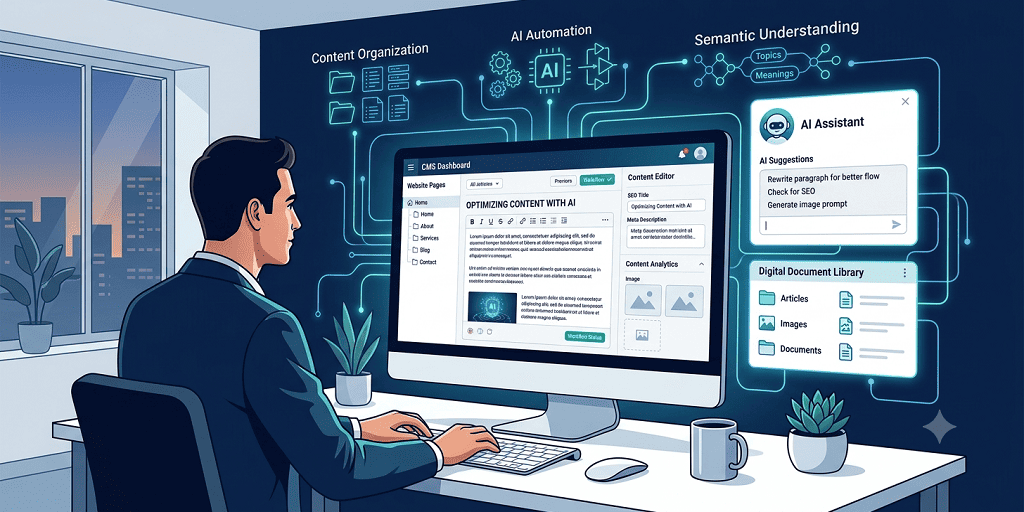
- An AI SEO CMS builds search tasks (metadata, structured data, internal links, refresh scheduling) into the publishing workflow instead of adding them afterward.
- A traditional CMS handles publishing well but leaves optimization to plugins and manual audits.
- Test any CMS on five points: schema, speed, brand voice, content refresh, and AI search visibility tracking.
- Teams with small headcounts and agencies running many sites gain the most.
What Is an AI SEO CMS?
An AI SEO CMS is a content management system that uses AI to handle optimization work inside the editor and publishing pipeline, including keyword mapping, metadata, schema markup, internal linking, and performance monitoring. In 2026, a CMS that only stores and publishes pages no longer meets the demands of search.
Search now spans classic results, AI Overviews, and chat-based answers. Each rewards clear structure, accurate entities, and fresh content. A CMS that cannot produce those signals consistently pushes the work onto people, and that work rarely scales past a few dozen pages.
Where a Traditional CMS Falls Short
Most legacy systems were designed around layout and permissions. SEO arrived later through plugins, each with its own settings and update cycle. The result is fragmented ownership: one tool for redirects, another for schema, a spreadsheet for refresh dates.
Three failures appear most often:
- Inconsistent metadata: titles and descriptions drift as multiple authors publish.
- Stale pages: nobody is alerted when a statistic or product detail ages out.
- No visibility feedback: teams see rankings but not whether AI assistants cite their pages.
AI SEO CMS vs Traditional CMS: 5 Differences
CapabilityTraditional CMSAI SEO CMSMetadataWritten by hand or via pluginDrafted automatically and checked against page intentStructured dataManual JSON-LD or add-onsGenerated per content typeBrand voiceStyle guide documentApplied inside the drafting workflowContent refreshPeriodic manual auditsFlagged by age and performance signalsAI search trackingNot availableMonitors mentions and citations in AI answers
How to Evaluate an AI SEO CMS
Run a short pilot before committing. Publish ten pages and score the platform against these checks:
- Schema accuracy: validate output with Google's structured data documentation and its Rich Results Test.
- Performance: confirm pages pass Core Web Vitals, including a Largest Contentful Paint under 2.5 seconds.
- Editorial control: every AI suggestion should be reviewable before it goes live.
- Voice fidelity: drafts should match your tone without heavy rewriting.
- Reporting: dashboards should show both search rankings and AI answer visibility.
Human review matters here. Google's guidance on creating helpful, people-first content applies regardless of how a page was drafted, so the CMS should speed up editors and never replace them.
Who Benefits Most
Agencies managing 20 or more client sites gain consistency, since templates and rules apply across every property. SMB operators without a dedicated SEO hire gain a baseline of technical hygiene. Marketing leaders gain a single view of content health instead of reconciling several tools.
Conclusion
A CMS that cannot automate structured data, refresh alerts, and AI visibility tracking will strain under modern SEO demands. Platforms such as WorkspaceCMS.ai - SEO + AI Campaign combine AI site building, brand-voice blogging, and AI search tracking in one workspace, which gives teams a practical reference point when comparing options.
Can Your CMS Handle Modern SEO? Exploring the Role of an AI SEO CMS FAQ
Does an AI SEO CMS replace an SEO specialist?
No. It automates repetitive tasks such as metadata and schema, while specialists still set strategy, review output, and interpret results.
Can I add AI SEO features to my current CMS with plugins?
Yes, partly. Plugins cover metadata and schema, but they rarely connect drafting, refresh alerts, and AI search tracking into one workflow.
How long does a CMS pilot take?
Two to four weeks is enough to publish ten pages, validate schema, and compare editing time against your current process.

 English
 Arabic
 French
 Spanish
 Portuguese
 Deutsch
 Turkish
 Dutch
 Italiano
 Russian
 Romaian
 Portuguese (Brazil)
