

Industrial Effluent Treatment Plant in India – Benefits, Applications and Working Process
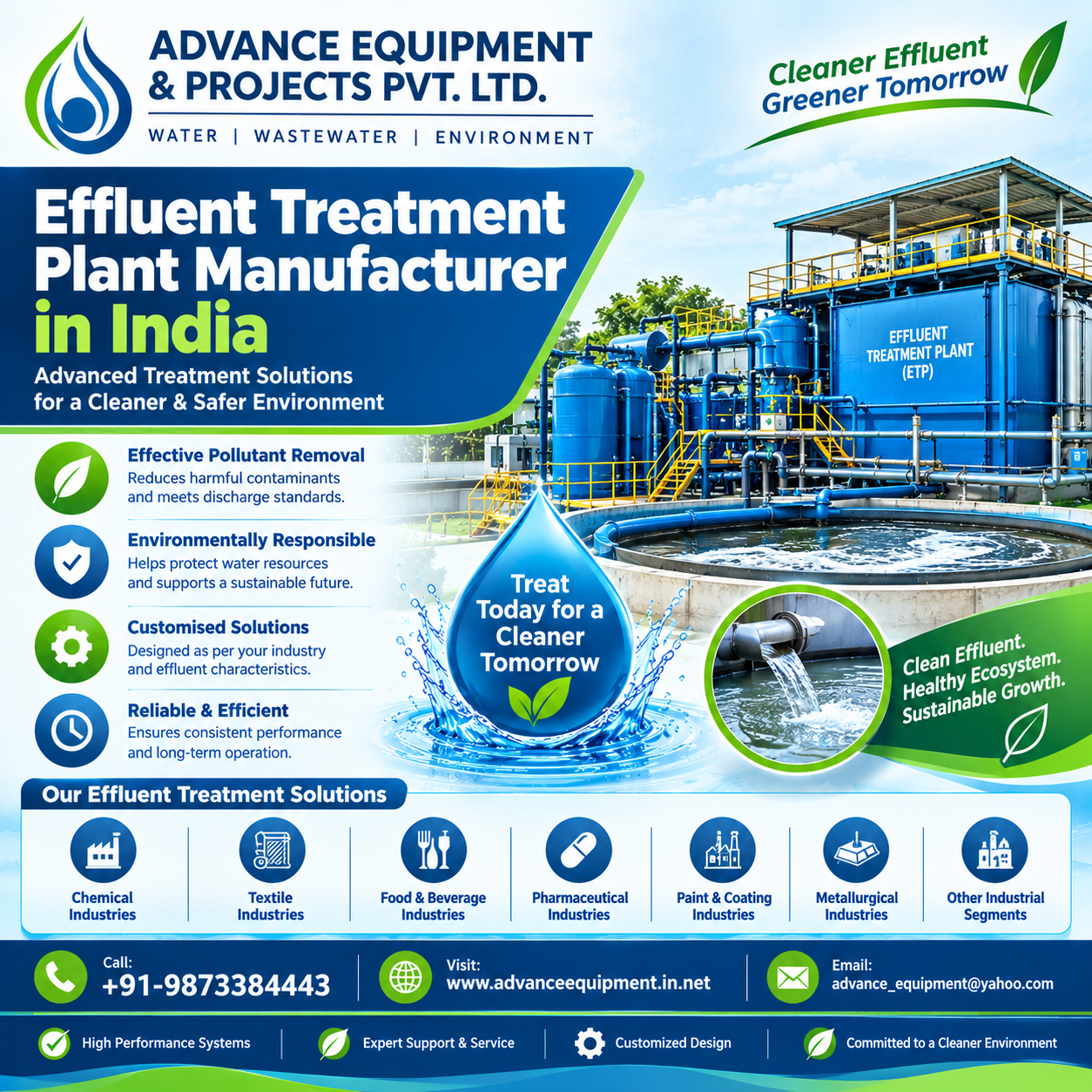
Industrial facilities require effective wastewater management to reduce environmental risks and support responsible operations. Wastewater from manufacturing processes can contain organic matter, suspended solids, oils, chemicals, colour, and other pollutants that need appropriate treatment.
An Industrial Effluent Treatment Plant (ETP) is designed to treat wastewater according to its characteristics and the quality required for discharge or reuse.
Advance Equipment & Projects Pvt. Ltd. provides water and wastewater treatment equipment solutions for different industrial requirements.
What Is an Industrial ETP?
An industrial ETP is a treatment system designed to manage wastewater generated by manufacturing and processing operations.
Unlike domestic sewage, industrial effluent can vary significantly between sectors. For example, textile wastewater may contain colour and process chemicals, while food-processing wastewater may contain high concentrations of biodegradable organic matter and fats.
For this reason, an ETP must be designed around the specific wastewater being treated.
Key Benefits of Industrial Effluent Treatment
Better Wastewater Management
An ETP provides a structured process for collecting and treating industrial wastewater before discharge or potential reuse.
Pollutant Reduction
Appropriate treatment can reduce contaminants such as suspended solids, organic pollutants, oils, and certain chemicals.
Support for Environmental Responsibilities
Effective treatment can help industries manage wastewater in line with applicable environmental requirements.
Potential Water Conservation
Where treatment quality is suitable, some treated effluent may be reused for approved industrial or non-potable applications.
Improved Process Control
Monitoring wastewater flow, pH, and other relevant parameters can help operators identify variations and maintain treatment performance.
Industrial Applications of ETP Systems
Chemical Industries
Chemical wastewater may require pH adjustment, chemical treatment, separation, and additional processes based on its composition.
Textile and Dyeing Industries
Textile effluent may contain colour, suspended solids, salts, and chemicals. Treatment technology must be selected according to the specific wastewater characteristics.
Food and Beverage Industries
Wastewater from food processing may contain biodegradable organic matter, oils, and suspended solids. Appropriate treatment may combine physical and biological processes.
Pharmaceutical Industries
Pharmaceutical wastewater can vary significantly in composition and may require specialized treatment based on the compounds present.
Paint and Coating Industries
Wastewater from these operations may contain pigments, suspended solids, solvents, or other chemicals, requiring an application-specific treatment design.
How Does an Industrial ETP Work?
The process varies by industry, but a typical system may include the following stages:
-
Collection and screening: Wastewater is collected and larger solids are removed.
-
Equalization: Flow and pollutant variations are balanced.
-
pH adjustment: Acidity or alkalinity is adjusted where required.
-
Primary treatment: Chemical treatment or physical separation removes selected contaminants.
-
Biological treatment: Microorganisms reduce biodegradable organic matter where appropriate.
-
Clarification: Suspended solids are separated from the treated water.
-
Filtration or advanced treatment: Additional processes are used when needed to meet the required quality.
-
Sludge management: Sludge is collected, treated, and handled according to its characteristics and applicable requirements.
Not every ETP requires all these stages. The correct process depends on wastewater analysis and the intended discharge or reuse application.
Important Factors in ETP Plant Design
Before installing an industrial effluent treatment plant, businesses should evaluate:
-
Average and peak wastewater flow
-
BOD, COD, TSS, pH, and other relevant parameters
-
Presence of oils, metals, colour, or specific chemicals
-
Variations in production and wastewater quality
-
Required treated-water quality
-
Available space and utilities
-
Sludge treatment and disposal arrangements
-
Energy consumption and chemical requirements
-
Routine monitoring and maintenance needs
Laboratory testing and an engineering assessment help determine the appropriate treatment process.
Choosing an ETP Manufacturer and Supplier in India
When comparing ETP suppliers, review the proposed treatment process, equipment specifications, design assumptions, expected treated-water quality, operating requirements, and maintenance arrangements.
Ask how the proposed design addresses the actual pollutants present in your wastewater rather than relying on a generic plant configuration.
Advance Equipment & Projects Pvt. Ltd. provides water and wastewater treatment equipment solutions for industrial applications. Contact the company to discuss your project and technical requirements.
Contact Details
Advance Equipment & Projects Pvt. Ltd.
Phone: +91-9873384443
Website: https://www.advanceequipment.in.net/
Email: advance_equipment@yahoo.com
Conclusion
An industrial ETP helps treat wastewater based on the contaminants present and the quality required after treatment. Effective system selection requires careful evaluation of wastewater characteristics, treatment technology, operating costs, and applicable environmental standards.
If you are looking for an Industrial Effluent Treatment Plant Manufacturer in India, contact Advance Equipment & Projects Pvt. Ltd. to discuss your project requirements.

 English
 Arabic
 French
 Spanish
 Portuguese
 Deutsch
 Turkish
 Dutch
 Italiano
 Russian
 Romaian
 Portuguese (Brazil)
