

How to Evaluate Skill Position Shoulder Pads for Speed, Comfort and Proper Coverage
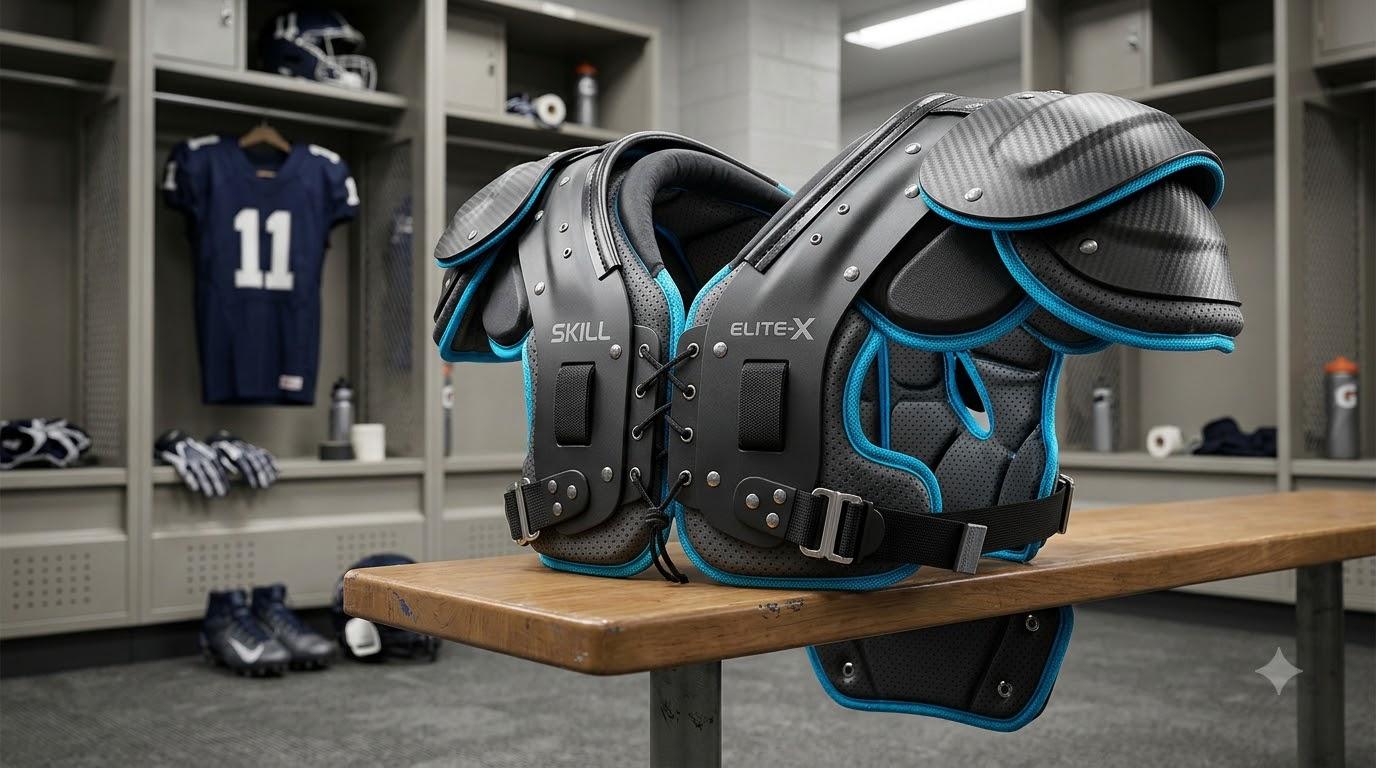
A football player may be quick and technically skilled but still become distracted by equipment that shifts, rubs, or restricts comfortable movement. For players who need to accelerate, turn, reach, and react quickly, the fit of their shoulder pads deserves careful attention.
When comparing skill position shoulder pads for comfortable movement and an appropriate equipment fit, start with the athlete's actual needs rather than choosing solely by appearance. The pads must fit correctly, provide the coverage specified by their design, work with the player's uniform, and comply with the relevant league requirements.
There is no single model that automatically suits every skill-position athlete. A structured fitting and comparison process helps families and coaches make a more informed decision.
What Makes a Good Fit for a Skill Player?
A suitable fit should keep the pads in their intended position without creating uncomfortable pressure or restricting normal movement. The equipment should not need constant adjustment during drills.
Skill-position players often make repeated arm and torso movements, so a fitting should include more than standing still in front of a mirror. The athlete should raise the arms, reach forward, rotate, and adopt a football stance while the pads are secured according to the manufacturer's instructions.
Pay attention to the following:
-
Does the equipment remain in position?
-
Can the player move the arms comfortably?
-
Does the fit create pressure around the shoulders, neck, or chest?
-
Does the jersey sit properly over the pads?
-
Are all adjustment points secured as directed?
-
Does the model meet the competition's equipment requirements?
If the player reports pain or significant restriction, stop and reassess the fit. Do not assume that discomfort is an unavoidable part of wearing protective equipment.
Match the Evaluation to the Player's Role
Receivers who need to reach and turn
Receivers regularly reach for passes, rotate their upper bodies, and change direction. During a fitting, evaluate comfortable arm elevation and torso movement.
Check whether the equipment remains correctly positioned as the player reaches forward and overhead. A pad that shifts or rubs repeatedly may need a different fit or adjustment according to the manufacturer's guidance.
Defensive backs who need to react
Defensive backs change direction while tracking opponents and the ball. Ask the athlete to adopt a stance, turn, and move through controlled directional changes.
The objective is to find equipment that fits securely and does not interfere with the player's normal movement. Position-specific drills should be performed only when appropriate for the fitting and supervision available.
Players who perform multiple roles
Some athletes move between offensive and defensive assignments. Their equipment needs should reflect the full range of roles they play, as well as the requirements of the competition.
Do not assume that a pad suitable for one role automatically satisfies every requirement for another. Confirm the applicable rules and intended use.
A Practical Comparison Process
Step 1: Confirm the applicable rules. Check the league, age-group, and position requirements before comparing models.
Step 2: Measure the player. Follow the manufacturer's sizing guidance. Avoid using jersey size or age as a substitute for the required measurements.
Step 3: Compare current product specifications. Review the model's intended use, adjustment features, and listed design. Do not assume that all pads have the same construction or coverage.
Step 4: Fit the equipment correctly. Position and secure the pads according to the instructions.
Step 5: Test comfortable movement. Have the player raise the arms, reach, rotate, and adopt a normal stance. Check for pressure, rubbing, or shifting.
Step 6: Wear the full uniform. Put on the game jersey and any other required equipment. Check for bunching or interference.
Step 7: Compare fit and feedback. If multiple models are available to try, assess each using the same sequence rather than relying on first impressions.
Step 8: Inspect before use. Check the shell, straps, padding, and other components for visible damage.
Practical Example 1: A Player Reports Rubbing During Practice
A defensive back tells the coach that the equipment rubs near the shoulder during repeated turns. The player has worn the same model for several weeks, so the coach initially assumes it is normal.
The team pauses to inspect the fit. The parent checks the sizing instructions, the position of the pads, and the way the jersey sits over the equipment. The player repeats the movement that caused the discomfort.
If the rubbing persists, the family should reassess the fit or seek advice from the manufacturer or a qualified equipment specialist. Continuing to use uncomfortable equipment without investigating the cause is not a good solution.
Practical Example 2: Comparing Equipment Before Purchase
A parent is choosing new pads for a teenager who plays both receiver and defensive back. Two models have different designs, and the product descriptions do not provide enough information to decide from photographs alone.
The parent reviews each model's specifications, checks the current size guidance, and confirms the competition requirements. Where possible, the player tries each option and performs a consistent movement check with the jersey on.
The decision is based on the fit, comfort, design, and applicable rules. This is more reliable than assuming that the model marketed for a particular position must be right for every athlete in that role.
Illustrative Case Study: Standardising Equipment Fittings
This is a hypothetical example, not a documented customer result.
A school team notices that players evaluate equipment differently. Some choose the first model that feels comfortable while standing, while others focus mainly on the appearance of the pads.
The coach introduces a common fitting sequence: measure, inspect, secure, test movement, add the jersey, and review player feedback. Families use the same process when comparing models, and unresolved fit concerns are addressed before full practice.
The team now has a consistent way to identify problems. This does not establish that one particular pad is best for everyone; it helps ensure that individual equipment choices are assessed using the same practical criteria.
A Comparison Table for Parents and Coaches
|
Evaluation area |
What to check |
Question to ask |
|
Sizing |
Current measurements and manufacturer's instructions |
Does the model fit the player as intended? |
|
Movement |
Reaching, turning, and adopting a stance |
Can the athlete move comfortably? |
|
Positioning |
Whether the pads shift during movement |
Do they remain in their intended position? |
|
Coverage |
Product specifications and league rules |
Does the setup meet applicable requirements? |
|
Uniform fit |
Jersey and other equipment worn together |
Are there uncomfortable overlaps or restrictions? |
|
Condition |
Straps, shell, padding, and visible wear |
Is the equipment in suitable condition? |
Use the table to compare models consistently. If a product description leaves an important question unanswered, seek clarification rather than filling the gap with assumptions.
Common Equipment Selection Errors
Choosing by marketing language alone
Words such as “lightweight,” “flexible,” or “performance” do not replace a proper fitting. Review actual specifications and evaluate the athlete's comfort.
Ignoring the complete uniform
A pad may seem suitable on its own but feel different once the jersey and other equipment are added. Always assess the full setup.
Assuming one design works for every player
Athletes have different measurements, movement patterns, and equipment requirements. Choose for the individual rather than treating the position as the only deciding factor.
Overlooking maintenance
Straps, padding, and other components can wear over time. Inspect the equipment regularly and follow the manufacturer's care instructions.
Waiting until competition
Address fit concerns during pre-season checks. Do not leave sizing or comfort problems until game day.
Maintaining the Fit Through the Season
A correct fit at the start of the season does not guarantee that the equipment will remain suitable indefinitely. Young athletes grow, uniforms change, and repeated use can affect equipment condition.
Inspect the pads before use, check adjustment points, and pay attention to any new discomfort. Recheck fit after noticeable growth or changes in the player's equipment.
Follow the manufacturer's cleaning and maintenance instructions. Do not modify the equipment or attempt unauthorised repairs. If there is uncertainty about damage or suitability, seek qualified guidance before returning the pads to use.
Conclusion
Evaluating skill-position equipment requires a consistent process. Confirm the competition rules, measure the player, review the model's specifications, and check fit during comfortable football movements. Then test the pads with the full uniform and inspect the equipment for damage.
The most appropriate option is not automatically the smallest, lightest, or most heavily promoted model. It is the one that fits the athlete, meets the applicable requirements, and supports comfortable movement as intended.
Frequently Asked Questions
1. What should I look for in skill-position shoulder pads?
Check sizing, fit, comfortable movement, the model's stated coverage, uniform compatibility, and compliance with the relevant competition rules.
2. Are all skill-position pads designed the same way?
No. Designs and features can differ. Review the current specifications of the particular model instead of assuming that all products offer the same configuration.
3. How do I check movement during a fitting?
Have the player raise the arms, reach forward, rotate the torso, and adopt a football stance. Stop and reassess if these movements cause pain or significant restriction.
4. Should the jersey be part of the fitting?
Yes. The complete uniform can reveal bunching or pressure that is not obvious when the pads are worn alone.
5. When should the equipment be replaced?
Reassess equipment if it no longer fits, shows damage, cannot be secured as intended, or does not meet current requirements. Follow manufacturer guidance and seek qualified advice when uncertain.
6. Do skill-position shoulder pads guarantee protection from injury?
No. No shoulder pad can eliminate every injury risk. Proper fit, appropriate equipment, coaching, technique, and following the rules all remain important.

 English
 Arabic
 French
 Spanish
 Portuguese
 Deutsch
 Turkish
 Italiano
 Russian
 Romaian
 Portuguese (Brazil)
 Greek
