

Organic Herbal Tinctures: How to Check Ingredients, Dosage and Safety
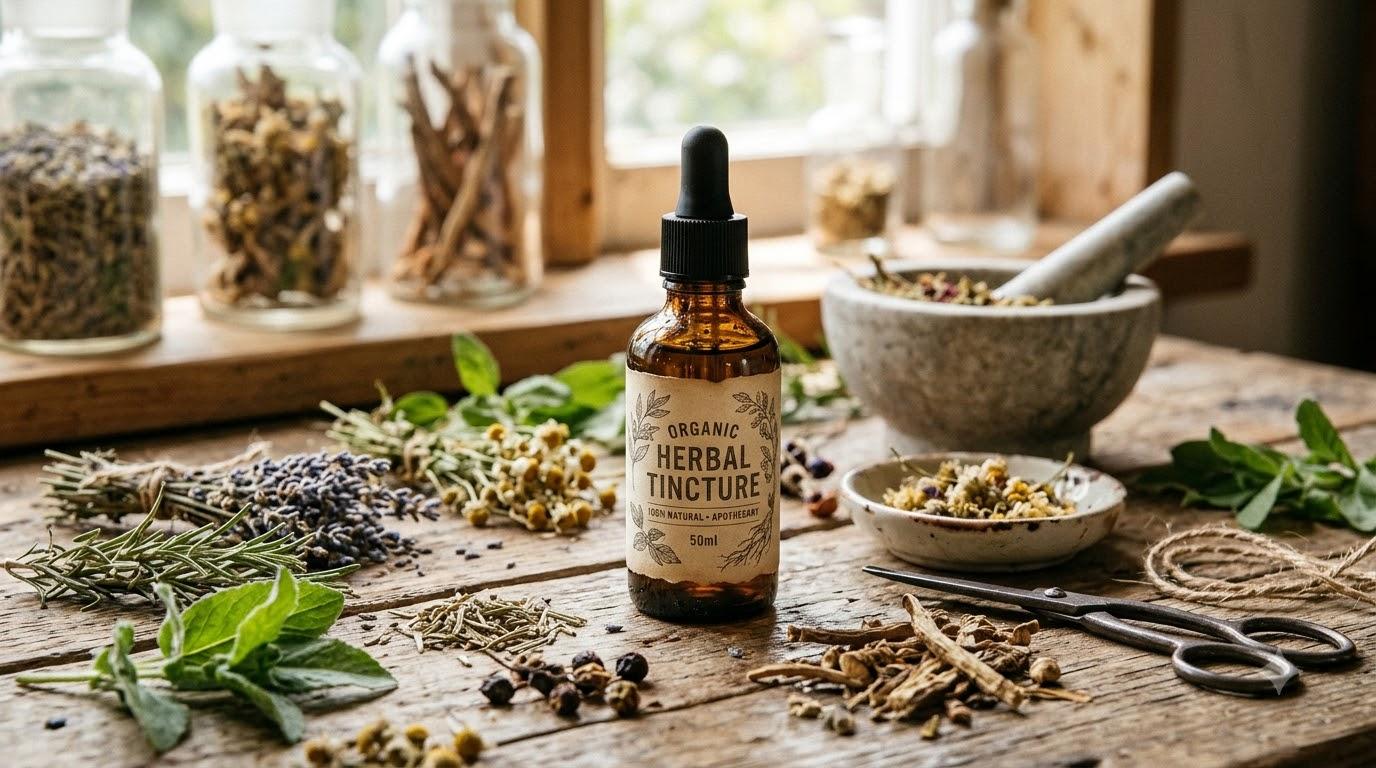
Organic Herbal Tinctures: How to Choose Carefully and Use Them Responsibly
Herbal tinctures can appeal to people who prefer liquid botanical preparations, but choosing one involves more than finding an herb with a promising reputation. The plant species, extraction method, concentration, other ingredients, directions, and possible medication interactions all matter. Before exploring organic herbal tinctures for a more informed botanical wellness routine, learn how to read the label, identify information that is missing, and recognise when professional advice is necessary.
A tincture is generally a liquid preparation made by extracting constituents from plant material into a liquid, often alcohol, glycerin, or another suitable solvent. Formulations differ, so the term does not tell you exactly what is in the bottle or how concentrated it is.
The word “organic” also needs careful interpretation. It may refer to the sourcing of particular ingredients or a defined certification, but it does not automatically prove that a tincture is effective, safe for everyone, or suitable for a particular health condition.
What information should a tincture label provide?
A useful label should help you identify the product and understand how it is intended to be used. If important details are missing, you may not be able to evaluate whether the product fits your needs.
Start with these questions:
-
Which plant is used? Common names can refer to different species. A botanical or scientific name can help clarify the ingredient's identity.
-
Which plant part is included? Roots, leaves, flowers, seeds, and bark can have different chemical profiles.
-
What is the extraction liquid? Alcohol-based and alcohol-free preparations are not necessarily interchangeable.
-
Is the concentration explained? Look for any stated extract ratio, strength, or standardisation information, while recognising that these details do not independently prove effectiveness.
-
What are the serving instructions? Confirm the recommended amount, frequency, route of use, and any stated restrictions.
-
Are other ingredients listed? Check for alcohol, sweeteners, flavourings, preservatives, and ingredients that may trigger an allergy.
If you cannot establish what the product contains, do not guess the serving amount. Ask the manufacturer or seller for clarification before using it.
What does “organic” mean for an herbal extract?
An organic claim generally relates to how ingredients are produced and handled under an applicable standard. The precise scope depends on the certification and the product's origin. It is important to distinguish an organic ingredient from a finished product that has been certified under a specific standard.
Organic status does not establish that a plant extract contains a particular amount of an active compound. Nor does it demonstrate that the extract has been tested in clinical trials or that it is appropriate for every person.
A responsible comparison therefore considers both sourcing and formulation. You may care about organic agriculture, but you should also want clear ingredient identification, sensible directions, appropriate quality controls, and realistic product claims.
|
Information to assess |
Why it matters |
What to do if it is unclear |
|
Botanical identity |
Helps distinguish the intended plant from similarly named species |
Ask for the full plant name |
|
Plant part |
Different parts can contain different constituents |
Confirm the part used in the preparation |
|
Extraction liquid |
May affect suitability for people avoiding alcohol or certain ingredients |
Check the label and ask about alternatives |
|
Concentration or extract ratio |
Helps describe how the preparation was made |
Ask for an explanation rather than comparing numbers without context |
|
Organic certification |
Clarifies which sourcing or production standard is claimed |
Ask which ingredients and stages the certification covers |
|
Serving instructions |
Helps prevent accidental misuse |
Do not invent a dose if directions are absent |
|
Warnings and interactions |
Helps identify circumstances requiring professional advice |
Discuss the product with a pharmacist or clinician |
No single label detail proves that a tincture is safe or effective. The goal is to gather enough information to make a reasonable, informed decision.
Why herbal products can interact with medicines
Plants contain biologically active substances. Depending on the herb, the preparation, and the individual, these substances may affect the body or alter how certain medicines work.
The National Center for Complementary and Integrative Health highlights potential interactions and contamination as important safety concerns for herbal and dietary supplements. St John's wort, for example, is known to interact with multiple medicines. This does not mean every herb causes an interaction, but it does mean that “natural” is not a reliable safety guarantee.
Interaction information is incomplete for many botanical products. The absence of a known interaction should not be interpreted as proof that no interaction is possible, especially when the product contains several herbs or the person takes multiple medicines.
Before using organic herbal tinctures, discuss the exact product with a pharmacist or healthcare professional if you take prescription medication, use over-the-counter medicines regularly, have a chronic health condition, or are preparing for surgery. This is particularly important for medicines where small changes in drug levels can have serious consequences.
Do not stop or change prescribed medication to accommodate an herbal product without professional advice.
How to evaluate a tincture without relying on marketing promises
Descriptions such as “balancing,” “restorative,” “traditional,” or “supportive” may appear on wellness products. These words do not necessarily tell you whether a particular preparation has been tested for a specific outcome.
Evaluate claims according to the type of evidence needed to support them.
-
Identify the promised outcome. Is the product being presented as a general wellness item or as a solution for a named health condition?
-
Check the actual ingredient. Evidence about one plant species does not automatically apply to another species or a mixed formula.
-
Consider the preparation. A study of a concentrated extract, for example, may not apply to a different tincture with another extraction method.
-
Look for realistic wording. Be cautious of guarantees, claims to cure multiple unrelated conditions, or advice to replace established treatment.
-
Check for safety information. A product should not be judged solely on the benefits described in its marketing.
-
Ask for clarification. If the serving, ingredients, or warnings are unclear, request further information before use.
A product can be traditionally used without having strong clinical evidence for every advertised benefit. Acknowledging that distinction makes it easier to decide whether the product meets your expectations.
Choosing between alcohol-based and alcohol-free preparations
Some tinctures use alcohol as an extraction liquid, while others use glycerin, water, or another formulation. These differences can affect taste, stability, extraction characteristics, and suitability for particular users.
Someone avoiding alcohol for personal, religious, medical, or recovery-related reasons should check the actual formulation rather than assuming that a small serving contains none. Alcohol-free does not automatically mean safer or more effective; the complete ingredients and intended use still matter.
Do not assume that two products made from the same plant are interchangeable. Different extraction processes may produce different preparations, and the recommended serving for one product should not be transferred to another.
If you are buying a tincture for a child, during pregnancy or breastfeeding, or for someone with a significant medical condition, seek individual professional advice before use. Safety cannot be established from the product category alone.
A step-by-step safety check before using a tincture
A short review can help you catch important questions before introducing a new product.
Step 1: Read the full label. Identify the plant, plant part, other ingredients, extraction liquid, and serving instructions.
Step 2: Check your circumstances. Consider your medicines, allergies, medical conditions, and whether you need to avoid alcohol or particular ingredients.
Step 3: Ask a professional about interactions. Give a pharmacist or clinician the exact product label or a clear photograph of it. Do not rely on a general question about the herb if the finished preparation contains multiple ingredients.
Step 4: Follow the stated directions. Do not increase the amount because you expect faster results, and do not assume that more concentrated means better.
Step 5: Keep a record. If a qualified professional confirms that use is appropriate, note the product, amount taken, timing, and any unexpected symptoms.
Step 6: Stop and seek advice if needed. If you develop a concerning reaction, stop using the product and seek appropriate medical guidance. Severe allergic symptoms or other urgent symptoms require emergency care.
This process is not a guarantee of safety. It is a practical way to reduce avoidable uncertainty before using a botanical preparation.
Illustrative Case Study: A customer checks a tincture before starting it
Jordan, a hypothetical adult, considers a new herbal tincture after seeing a claim that it supports general wellness. Jordan takes a prescription medicine and initially assumes the tincture is harmless because it is plant-based.
Before purchasing, Jordan checks the label and discovers that the product contains more than one botanical ingredient and an alcohol-based extraction liquid. Jordan sends the ingredient details to a pharmacist and asks whether the formulation could interact with the prescribed medicine.
The pharmacist reviews the actual ingredients and advises Jordan on the next step. Jordan does not start the tincture until the question has been addressed.
This example demonstrates the value of checking the finished product rather than evaluating an herb in isolation. It is hypothetical and does not describe a real customer or establish the safety of any specific tincture.
Reviewing a brand and its product information
A product page should make it possible to understand what is being offered. Look for the full ingredient list, serving instructions, warnings, storage guidance, and contact details for questions. If the product claims organic status, check what that claim covers.
Soul Seed Solutions includes tinctures in its product range. You can visit Soul Seed Solutions to explore the brand and review its available product information. For the specific tincture you are considering, verify the ingredients and directions rather than assuming all products in the collection have the same composition.
If the page does not explain an important detail, ask the seller. A clear response may help you assess whether the product suits your preferences, but a seller's description is not a substitute for independent medical advice about interactions or treatment.
Storage and responsible use
Follow the storage instructions on the label, keep the container securely closed, and store it away from children. Avoid transferring the liquid into an unlabelled container, because doing so can remove important information about its identity and use.
Do not use a product that appears contaminated, has changed unexpectedly, or is beyond its stated usable period. Never assume that a tincture can be safely mixed with another product or that a serving can be increased without consequence.
Keep a record of any botanical products you use and share it with your healthcare providers. This can help them consider possible interactions if you develop symptoms or need a new medicine.
When professional advice is especially important
Seek professional guidance before using a tincture if you take prescription medicines, have liver or kidney disease, have a history of significant allergies, are pregnant or breastfeeding, or are considering use for a child. The relevant risks depend on the specific herb, preparation, and individual circumstances.
If you are trying to manage persistent symptoms, get the underlying problem assessed. A tincture should not delay diagnosis or replace an established treatment without advice from a qualified healthcare professional.
Conclusion
Choosing a tincture responsibly means checking more than the word “organic.” Identify the plant and plant part, understand the extraction liquid and serving instructions, review the full formula, and consider potential interactions. Evidence for one botanical preparation should not automatically be applied to every product containing a similar ingredient.
Before introducing a new tincture, check the label and discuss potential risks with a pharmacist or healthcare professional when relevant. Clear information and realistic expectations are more useful than broad wellness promises.
Frequently Asked Questions
What is an herbal tincture?
A tincture is generally a liquid preparation made by extracting constituents from plant material into a liquid. The extraction method, solvent, and concentration vary between products.
Does organic certification prove that a tincture works?
No. Organic certification concerns specified production or sourcing standards. It does not independently establish clinical effectiveness or suitability for a medical condition.
Can herbal tinctures interact with prescription medicines?
Yes, some botanical products can affect how medicines work or increase side effects. Ask a pharmacist or healthcare professional to review the exact product and your medication list.
Are alcohol-free tinctures always safer?
No. An alcohol-free formula may suit people who need to avoid alcohol, but safety also depends on the herbs, concentration, other ingredients, and individual circumstances.
How should I decide how much tincture to take?
Follow the directions for the exact product and do not invent or increase a serving. If the label is unclear or the product is intended for a medical concern, ask a qualified professional.
Can a tincture replace prescribed treatment?
Do not replace or stop prescribed treatment without professional guidance. If symptoms persist, seek assessment rather than relying on an herbal product alone.

 English
 Arabic
 French
 Spanish
 Portuguese
 Turkish
 Dutch
 Italiano
 Russian
 Romaian
 Portuguese (Brazil)
 Greek
