

Steel Fabrication ERP: The Complete Guide for Indian Fabricators
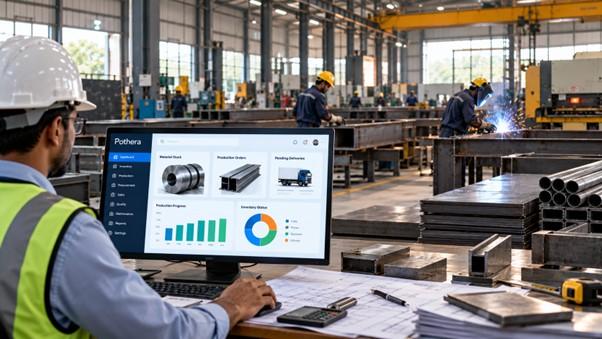
Steel fabrication ERP is business software that connects a fabricator’s enquiries, quotations, drawings, purchasing, stock, shop floor, outside processes, quality checks, dispatch and accounts in one database, so every job can be planned, tracked and costed from order to invoice. It replaces spreadsheets and disconnected tools, so stock, job cost and delivery status come from the same live data.
Pothera ERP is developed and implemented by Bsquare Solutions, which has built ERP software for manufacturers since 1999. This guide explains what steel fabricators should expect from an ERP, module by module, and how to choose and implement one.
What is in this guide?
- What steel fabrication ERP is, and how it differs from generic ERP
- How a steel job flows through the ERP
- The modules that matter
- Steel inventory management
- Job costing and cost per tonne
- Outside processes and job work
- Quality and traceability
- Compliance
- KPIs
- Implementation, cost and common mistakes
- FAQs
What is steel fabrication ERP, and how is it different from generic ERP?
A generic ERP handles accounts, stock and orders in standard ways. Steel fabrication adds problems a standard setup does not solve:
● Steel is bought by weight, cut by length and issued by piece
● Offcuts and remnants return to stock and must be reused
● Each job has its own drawing, bill of materials and revisions
● Material leaves for galvanising, painting or machining and must be reconciled
● Customers and inspectors ask for certificates and inspection records
● Margin depends on yield, scrap and the steel rate on the day you buy
A good steel fabrication ERP is configured around these realities. Pothera is modular and configurable, with user-defined fields, custom reports and 15+ industry solutions, including steel fabrication and the metal industry. See also our overview of ERP software for the steel industry and ERP for metal fabrication.
How does a steel fabrication job flow through an ERP?
|
Stage |
What happens |
What the ERP records |
Pothera module |
|
1. Enquiry and quote |
RFQ received, estimate prepared, quote sent |
Leads, quotations, follow-ups |
|
|
2. Order |
Customer confirms |
Sales order, pricing, delivery commitment |
|
|
3. Engineering |
Drawing and BOM prepared |
Multi-level BOM, routing |
|
|
4. Purchase |
Steel and consumables ordered |
Indents, purchase orders, supplier delivery tracking |
|
|
5. Stores |
Material received and issued |
Stock by store and location, batch and lot |
|
|
6. Shop floor |
Cutting, fit-up, welding, finishing |
Output, rejection, scrap and loss by machine, shift and operator |
Production and planning |
|
7. Outside processes |
Galvanising, painting, machining |
Challans, pending quantities, process loss |
|
|
8. Quality |
Inspection at each stage |
Incoming, in-process and final checks |
|
|
9. Dispatch and billing |
Goods leave, invoice raised |
E-invoice, dispatch record |
Sales and accounts and finance |
|
10. After-sales |
Complaints, warranty, service |
Service requests and history |
Because each stage feeds the next, data is entered once and used everywhere.
Which ERP modules does a steel fabricator need?
Pre-sales and sales. Track enquiries, quotations and follow-ups, and commit delivery dates with knowledge of stock and capacity.
Production and planning. Multi-level bills of materials, production orders and routings, with make-to-order, make-to-stock and mixed scenarios, plus order-wise progress. Read how ERP improves steel fabrication production planning and manufacturing scheduling ERP software.
Procurement and MRP. MRP works out what material is needed, in what quantity and by when, from confirmed demand, BOMs and stock. Indents and purchase orders go through approval workflows.
Inventory. Real-time stock of raw material, work in progress and finished goods. See ERP inventory management.
Job work and sub-contracting. Material issued to outside vendors against challans, with pending quantities and process loss tracked.
Quality. Checks at incoming material, in process and at final inspection, with accepted, rejected and rework quantities updating stock.
Accounts and finance. Purchases, sales, inventory movements and payroll post automatically, giving a real-time view of receivables, payables, cash flow and profitability.
HR and payroll, and asset management. HR and payroll and asset management keep people and machines in the same system.
Admin and security. Role-based and field-level authorisation, multi-level approvals and document attachments.
How does steel inventory management work in an ERP?
Steel inventory management means knowing exactly what steel you hold, where it is, which job it is reserved for and what it cost. In a steel fabrication business that covers coils, plates, sections, pipes, consumables, offcuts and finished parts.
Good steel inventory management software should let you:
|
Need |
What to look for |
|
Hold stock in the units you use |
Weight, length and pieces, with conversion |
|
Trace a lot |
Batch and lot provisions linked to receipt, issue and dispatch |
|
Keep certificates with the stock |
Documents, such as mill test certificates in PDF, attached to the receipt transaction |
|
Issue against jobs |
Job-wise issue, return and balance |
|
Reuse offcuts |
Remnants returned to stock rather than written off |
|
Avoid stock-outs and excess |
Reorder alerts and MRP-driven purchase |
|
Identify items quickly |
QR code integration |
Pothera provides real-time visibility of raw materials, work in progress and finished goods across stores and locations, with batch and serial number provisions, lot traceability, support for re-packing and re-processing, and QR code integration. Ask us to show how your heat-number and certificate records would be held on your own data. More on this: manufacturing inventory software solutions and inventory management software for manufacturing.
Good steel inventory software is also the foundation for everything else. Bsquare’s 2026 survey of 500 Indian manufacturers found that 71% named inventory inaccuracy as a top pain point before ERP, and that inventory management in the steel industry is where most fabricators first see value.
How do you cost a steel fabrication job and calculate cost per tonne?
Cost per finished tonne is:
(Material + labour + consumables + outside processes + overheads − scrap credit) ÷ finished tonnes
Worked example (illustrative). A job uses 20 tonnes of plate and yields 18.4 tonnes of finished steel (92% yield).
|
Item |
Amount |
|
Material: 20 t at ₹62,000/t |
₹12,40,000 |
|
Scrap credit: 1.6 t at ₹30,000/t |
−₹48,000 |
|
Labour |
₹1,80,000 |
|
Consumables |
₹60,000 |
|
Galvanising: 18.4 t at ₹9,000/t |
₹1,65,600 |
|
Overheads |
₹1,20,000 |
|
Total cost |
₹17,17,600 |
|
Cost per finished tonne |
about ₹93,348 |
Without an ERP, scrap, consumables and outside processes are usually estimated or added at month-end, so the real cost is known only after the job closes. In Pothera, costs are captured as work happens. You can define direct overheads for each BOM and account for scrap items, substitute items and production losses, to see the real cost of each product and order. Related reading: stop revenue leaks with steel ERP software and revenue planning with ERP.
How does ERP manage outside processes in steel fabrication?
Most fabricators send material out for galvanising, painting, plating or machining. The usual problems are not knowing what is still outside, who has it and what was lost in processing.
Pothera’s job work module issues material against challans, tracks pending quantities party-wise, receives processed goods back into production and accounts for process losses. See also how ERP helps with outsourcing manufacturing.
How does ERP support quality and traceability?
Quality problems found at final inspection are the most expensive to fix. In Pothera, checks can be configured at incoming material, at each production process and at final inspection, accepted, rejected and rework quantities update inventory automatically, and every inspection is recorded. Read how ERP software improves quality control in steel fabrication.
How does ERP help with compliance?
● GST e-invoicing through API integration, with QR code and digital signature integration, so compliant documents come out of the normal flow
● Job-work challans and e-way bills handled in the same system as stock
● Approvals and access control, so purchase orders and payments need the right sign-off
● Audit trail. Under Rule 3(1) of the Companies (Accounts) Rules, 2014, companies using accounting software must use software that records an edit log of each change and cannot disable it, from the financial year beginning 1 April 2023. Ask any vendor to demonstrate this live
● MSME payment rule. Under Section 43B(h), a deduction for amounts owed to micro and small suppliers can be deferred if payment goes beyond the limit (15 days without a written agreement, or the agreed period up to 45 days at most). Keep the supplier’s micro or small status in the vendor master
Rules change, so confirm current requirements with your CA.
Which KPIs should a steel fabricator track?
|
KPI |
What it tells you |
|
Material yield % |
How much steel becomes finished product |
|
Scrap and offcut % |
Where material is lost |
|
Job margin vs quote |
Whether pricing is accurate |
|
On-time delivery % |
Whether delivery promises hold |
|
Rework hours and cost |
The price of quality problems |
|
Machine utilisation |
Whether capacity is being used |
|
Outside-process turnaround |
How long material sits with vendors |
|
Days sales outstanding |
How fast you collect |
|
Stock accuracy |
How far records are from reality |
|
Open orders at risk |
Which jobs may slip |
Pothera’s integrated business intelligence turns data from every module into dashboards and reports, and email and WhatsApp alerts send approvals and exceptions to the right person.
How long does steel fabrication ERP implementation take?
Pothera ERP typically goes live in 8 to 12 weeks for 10 to 100 users, depending on scope, number of sites and data readiness.
|
Phase |
What happens |
|
1. Discovery |
Map your process from enquiry to invoice |
|
2. Configuration |
Set up BOMs, stages, approvals and masters |
|
3. Data migration |
{ "@context": "https://schema.org", "@type": "BlogPosting", "headline": "Steel Fabrication ERP: The Complete Guide for Indian Fabricators", "description": "<p class="MsoNormal" style="margin:12pt 0cm 12pt 0cm;"><strong><span lang="en-gb" xml:lang="en-gb">Steel fabrication ERP is business...", "image": "https://bout-ye.com/content/uploads/photos/2026/10/sngine_659346d0a62b5ec02335372a6f69d49a.jpg", "author": { "@type": "Person", "name": "Bsquare Solutions", "url": "https://bout-ye.com/bsquaresolutions" }, "publisher": { "@type": "Organization", "name": "Bout-ye", "url": "https://bout-ye.com" }, "datePublished": "2026-10-29 11:48:09", "dateModified": "2026-10-29 11:48:09", "mainEntityOfPage": { "@type": "WebPage", "@id": "https://bout-ye.com/blogs/10220/Steel-Fabrication-ERP-The-Complete-Guide-for-Indian-Fabricators" }, "url": "https://bout-ye.com/blogs/10220/Steel-Fabrication-ERP-The-Complete-Guide-for-Indian-Fabricators", "articleSection": "Outro", "keywords": "", "wordCount": "65535", "commentCount": "", "interactionStatistic": [{ "@type": "InteractionCounter", "interactionType": "https://schema.org/CommentAction", "userInteractionCount": "" }, { "@type": "InteractionCounter", "interactionType": "https://schema.org/ViewAction", "userInteractionCount": "" } ] } 
Bout-ye
https://bout-ye.com
|

 English
 Arabic
 French
 Spanish
 Portuguese
 Deutsch
 Turkish
 Dutch
 Italiano
 Russian
 Romaian
 Greek