

Climate Risk Management Market Size, Share and Forecast 2034
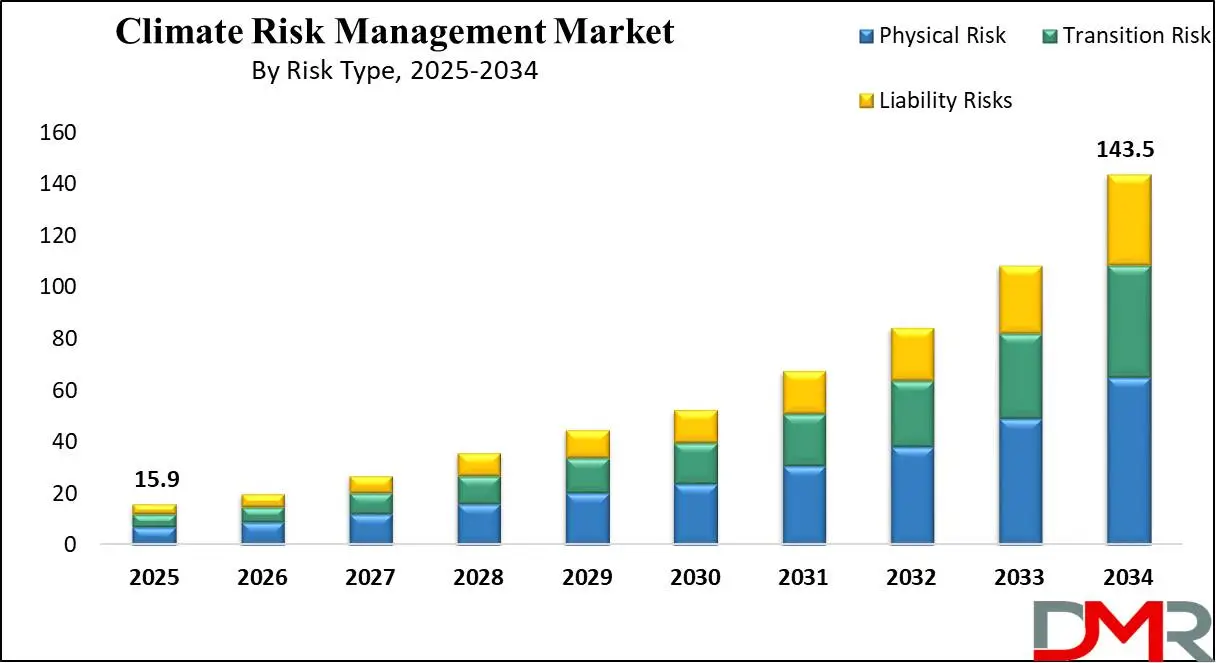
The global Climate Risk Management Market Size is becoming increasingly important as businesses, financial institutions, and governments evaluate their exposure to extreme weather, environmental changes, and climate-related economic risks.
According to Dimension Market Research, the global Climate Risk Management Market is projected to reach USD 15.9 billion in 2025 and increase to USD 143.5 billion by 2034, expanding at a CAGR of 27.7% during the forecast period.
Growing demand for climate scenario analysis, financial risk assessment, resilience planning, and technology-enabled monitoring is changing how organizations approach climate-related business decisions.
What Is Climate Risk Management?
Climate risk management includes the tools, strategies, services, and analytical processes used to identify, evaluate, monitor, and mitigate climate-related risks.
Organizations evaluate how environmental changes could affect physical assets, financial stability, business operations, investment portfolios, and supply chains.
The market generally distinguishes between three major risk categories.
Physical Risks involve direct environmental threats, including floods, storms, droughts, wildfires, and extreme temperatures.
Transition Risks arise from changes associated with the transition toward a lower-carbon economy, including evolving regulations, energy technologies, and market expectations.
Liability Risks involve potential legal and financial consequences associated with climate-related responsibilities and disclosures.
Understanding these distinctions helps organizations develop more targeted risk management strategies.
Why Is Climate Risk Management Demand Increasing?
Physical climate events can disrupt manufacturing facilities, transportation networks, agricultural production, and commercial infrastructure.
As organizations recognize these exposures, climate risk assessment is moving beyond sustainability reporting toward financial and operational decision-making.
Banks and insurers increasingly require analytical tools that help evaluate exposure across lending portfolios, insured assets, and investment holdings.
Businesses are also evaluating climate-related operational vulnerabilities across suppliers, production facilities, and geographic markets.
Technology is expanding the capabilities of climate risk management platforms. AI-assisted analytics, geospatial datasets, predictive modeling, and environmental monitoring can help organizations evaluate risks across multiple scenarios.
The commercial value lies in converting complex climate information into decisions about capital allocation, asset protection, insurance, and business continuity.
Get a Free Customized Sample of This or Any Other Market Research Report
https://dimensionmarketresearch.com/request-sample/climate-risk-management-market/
Climate Risk Management Market Segmentation
The market is segmented by risk type, solution, deployment mode, enterprise size, and industry vertical.
Risk Type
Physical Risks are expected to account for the largest share of the market in 2025.
Their importance reflects widespread organizational exposure to extreme weather and environmental disruptions.
Transition Risks and Liability Risks represent additional areas of concern for businesses evaluating regulatory changes, investment decisions, and legal exposures.
Solution Categories
The report examines Risk Assessment & Analysis, Risk Mitigation & Adaptation, Monitoring & Reporting Solutions, and Consulting & Advisory Services.
Risk assessment tools help organizations identify exposure, while mitigation and adaptation services translate findings into practical resilience measures.
Monitoring and reporting platforms support ongoing evaluation, documentation, and communication of climate-related risks.
Deployment and Enterprise Size
Cloud-based deployment is expected to generate the largest deployment revenue share in 2025.
Cloud platforms can support scalable climate data processing, collaboration, and integration with organizational risk management workflows.
Both Large Enterprises and Small & Medium Enterprises (SMEs) represent potential customers, although their implementation requirements and available resources differ.
Major Applications Across Industries
Financial Services & Insurance is a particularly important industry vertical because climate-related events can influence credit risk, underwriting decisions, portfolio valuation, and asset exposure.
Energy & Utilities organizations assess risks involving electricity generation, transmission infrastructure, fuel supply, and extreme weather events.
Agriculture & Forestry businesses use climate analysis to evaluate weather variability, water availability, and production uncertainty.
Manufacturing & Industrial organizations focus on physical assets, logistics networks, and supplier continuity.
Real Estate & Infrastructure businesses use climate modeling to assess location-specific exposure and support long-term investment planning.
Government & Public Sector organizations apply climate risk information to infrastructure resilience, public planning, and disaster preparedness.
Regional Outlook: North America Leads
North America is projected to account for approximately 37.2% of global Climate Risk Management Market revenue in 2025.
The region benefits from established financial services industries, demand for climate analytics, corporate risk management activity, and investments in resilience planning.
The US Climate Risk Management Market is projected at USD 5.0 billion in 2025, with a forecast CAGR of 26.0%.
Europe represents another important market as organizations respond to climate reporting expectations, financial exposure assessments, and sustainability-related regulatory developments.
Japan also presents opportunities as financial institutions and infrastructure operators evaluate natural hazard exposure and long-term climate resilience.
Competitive Landscape and Emerging Technologies
The report identifies KPMG, Deloitte, and RMS among important market participants.
Competition involves specialized climate analytics providers, consulting firms, data technology companies, and risk management solution developers.
Differentiation increasingly depends on the quality of climate datasets, scenario modeling, geographic coverage, analytical transparency, and integration with enterprise systems.
AI-driven analytics may strengthen the efficiency of processing complex environmental and financial information.
However, organizations must also evaluate model limitations, uncertainty, and differences between climate scenarios.
Challenges and Market Opportunities
High implementation costs, complex data integration, inconsistent datasets, and uncertainty surrounding regulatory developments remain important challenges.
Climate-related projections involve assumptions that require careful interpretation, especially when used for long-term investment decisions.
Opportunities exist in location-specific asset analysis, financial portfolio stress testing, enterprise risk dashboards, and climate adaptation planning.
Providers offering transparent methodologies and decision-relevant analytics may gain competitive advantages as buyers demand more reliable assessments.
Explore the Complete Climate Risk Management Market Analysis
https://dimensionmarketresearch.com/checkout/climate-risk-management-market/
Frequently Asked Questions
1. What is the current size of the Climate Risk Management Market?
The global market is projected at USD 15.9 billion in 2025 and is expected to reach USD 143.5 billion by 2034.
2. What is the expected CAGR of the Climate Risk Management Market?
The market is forecast to expand at a CAGR of 27.7% during the forecast period.
3. Which risk category leads the market?
Physical Risks are expected to account for the largest market share in 2025.
4. Which region dominates the Climate Risk Management Market?
North America is projected to lead with approximately 37.2% revenue share in 2025.
5. What technologies are transforming climate risk assessment?
AI analytics, geospatial data, climate modeling, cloud platforms, and continuous environmental monitoring are important technology trends.
Conclusion
Climate risk management is evolving into a critical business capability connecting environmental intelligence with financial and operational planning.
Increasing demand for climate analytics, resilience strategies, and integrated risk platforms offers opportunities for technology providers, consulting organizations, and financial services companies.
Long-term market development will depend on analytical accuracy, transparent methodologies, effective implementation, and the ability to transform climate information into actionable decisions.
Related Market Research Insights
The US Climate Risk Management Market Size examines climate-related financial exposure, regulatory developments, and the adoption of advanced risk assessment platforms across American businesses and financial institutions.
The Europe Climate Risk Management Market Share explores the region's climate analytics ecosystem, including demand from financial services, infrastructure operators, and enterprises managing evolving sustainability-related obligations.
The Japan Climate Risk Management Market Growth highlights the importance of disaster resilience, environmental risk assessment, and climate modeling for businesses and infrastructure operators in Japan.

 English
 Arabic
 French
 Spanish
 Portuguese
 Deutsch
 Turkish
 Dutch
 Italiano
 Russian
 Portuguese (Brazil)
 Greek
